

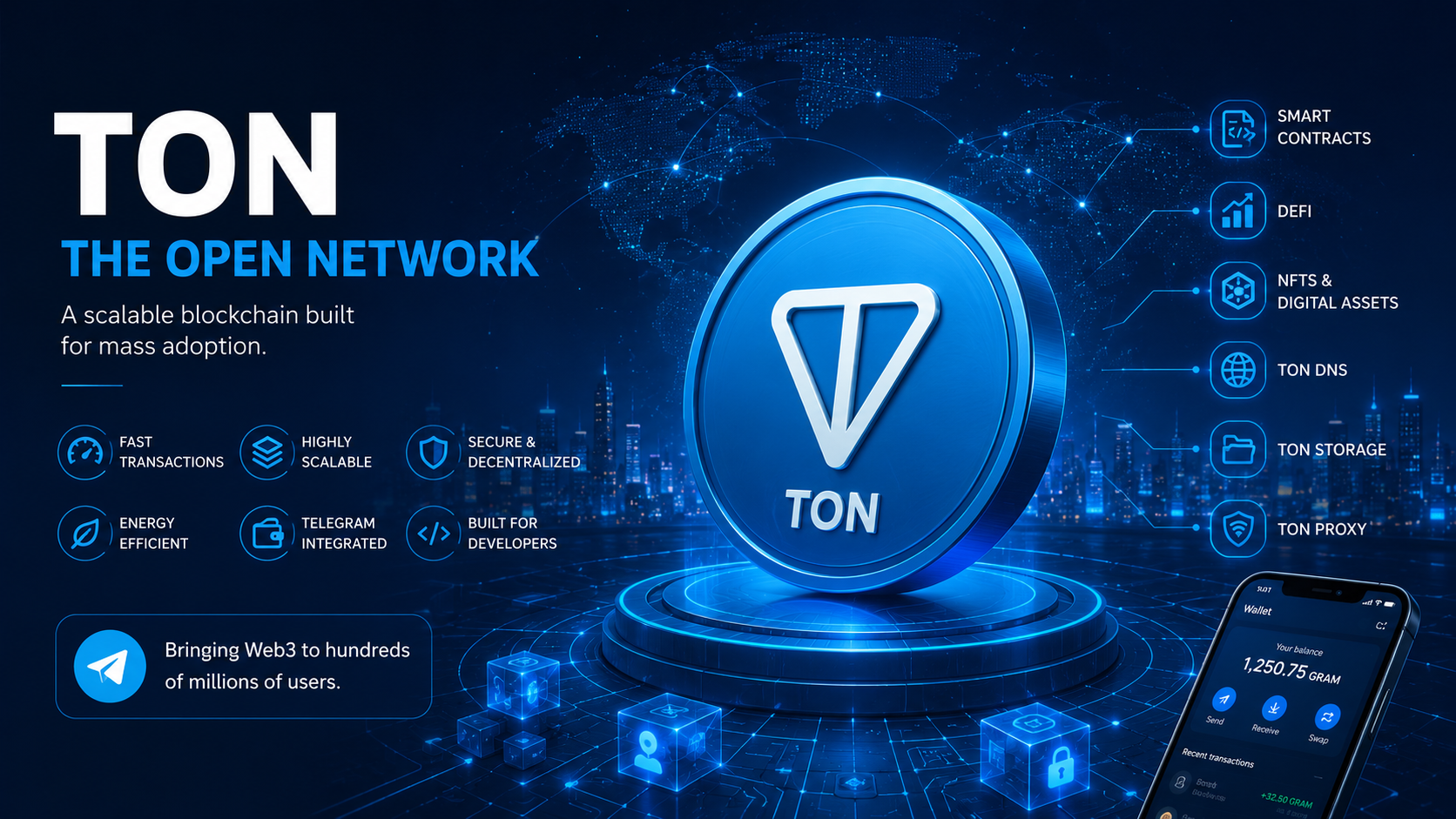
The Open Network (TON) is a high-performance Layer 1 blockchain designed to make cryptocurrency and decentralized applications fast, affordable, and easy to use. Originally conceived by the team behind Telegram, TON has evolved into an independent, community-driven ecosystem supporting payments, smart contracts, decentralized finance (DeFi), NFTs, gaming, and much more.
Built with scalability at its core, TON aims to handle millions of users without sacrificing speed or low transaction costs. Combined with growing integration into the Telegram ecosystem, TON has become one of the most closely watched blockchain networks in the industry.
What Is TON?
TON, short for The Open Network, is a decentralized blockchain platform that enables developers to build scalable decentralized applications (dApps) while allowing users to send digital assets quickly and securely.
Unlike blockchains that rely on a single chain to process every transaction, TON uses an advanced multi-chain architecture with dynamic sharding. This allows the network to process many transactions simultaneously, improving scalability while keeping fees low.
The blockchain is secured using a Proof of Stake (PoS) consensus mechanism, where validators stake the native cryptocurrency, Gram, to validate transactions and secure the network.
The History of TON
TON was originally announced by Telegram in 2018 under the name Telegram Open Network. The project attracted enormous interest thanks to Telegram's global user base and ambitious goal of bringing blockchain technology to millions of people.
Development came to an abrupt halt in 2020 after legal action by the U.S. Securities and Exchange Commission (SEC), which prevented Telegram from launching the project as originally planned.
Because the project's code was open source, independent developers and community members continued its development. The blockchain was renamed The Open Network (TON) and has since grown into an independent ecosystem maintained by contributors around the world.
The native cryptocurrency, previously known as Toncoin, has since been renamed Gram, reconnecting the token with its original identity while maintaining compatibility across the network.
How TON Works
TON is designed to process large numbers of transactions efficiently while remaining decentralized.
Instead of placing every transaction onto a single blockchain, TON distributes activity across multiple interconnected chains.
The network consists of:
- A masterchain that coordinates the network
- Multiple workchains with different capabilities
- Dynamic shardchains that automatically split or merge based on network demand
As activity increases, the blockchain can create additional shardchains to process transactions in parallel, significantly increasing throughput without causing congestion.
This design helps maintain fast confirmation times and low transaction fees even during periods of high usage.
Proof of Stake Consensus
TON uses Proof of Stake instead of energy-intensive mining.
Validators lock Gram as collateral and are responsible for:
- Validating transactions
- Producing new blocks
- Securing the blockchain
- Maintaining consensus
Validators receive staking rewards for their work, while users can often participate through staking pools without operating validator infrastructure themselves.
This approach dramatically reduces energy consumption compared to Proof of Work blockchains.
Gram: TON's Native Cryptocurrency
Every blockchain requires a native asset, and on TON that asset is Gram.
Gram is used for:
- Paying transaction fees
- Staking
- Running smart contracts
- Minting NFTs
- Using decentralized applications
- Participating in DeFi
- Registering TON DNS names
Because Gram powers nearly every activity on the network, it serves as the foundation of the TON ecosystem.
Smart Contracts and Decentralized Applications
TON allows developers to create smart contracts that execute automatically when predefined conditions are met.
These contracts enable a wide variety of decentralized applications, including:
- Decentralized exchanges (DEXs)
- Lending and borrowing platforms
- NFT marketplaces
- Blockchain games
- Payment systems
- Social applications
- Identity solutions
The network's scalability allows these applications to serve large numbers of users while maintaining responsive performance.
Telegram Integration
One of TON's most distinctive advantages is its relationship with Telegram.
Although Telegram no longer develops the blockchain itself, it has integrated numerous TON-powered features into its messaging platform.
Examples include:
- Integrated cryptocurrency wallets
- Peer-to-peer payments
- Telegram Mini Apps
- Digital collectibles
- Web3 services
These integrations make blockchain technology accessible through an interface that hundreds of millions of users already understand.
Decentralized Finance (DeFi)
TON supports a rapidly growing DeFi ecosystem.
Users can:
- Trade tokens
- Provide liquidity
- Stake assets
- Borrow cryptocurrencies
- Lend digital assets
- Earn rewards through yield-generating protocols
Low transaction fees and fast confirmations make TON well suited for financial applications that require frequent transactions.
NFTs and Digital Assets
TON supports non-fungible tokens (NFTs), allowing creators and developers to issue unique digital assets.
Common NFT use cases include:
- Digital artwork
- Gaming items
- Membership passes
- Event tickets
- Collectibles
- Domain names
Because network fees are relatively low, creating and transferring NFTs is often more affordable than on many older blockchain platforms.
TON DNS
TON includes a decentralized domain name system known as TON DNS.
Instead of using long wallet addresses, users can register readable names that simplify cryptocurrency payments and blockchain interactions.
This improves usability while reducing the chance of transaction errors.
TON Storage
TON Storage is a decentralized file storage system built within the ecosystem.
It enables users and applications to store files across a distributed network instead of relying solely on centralized cloud providers.
Potential use cases include:
- Website hosting
- Application data
- Digital archives
- Media distribution
TON Proxy
TON Proxy provides an additional privacy-focused network layer.
It allows users to access decentralized services with improved resistance to censorship while enhancing privacy during communication across the network.
Together with TON Storage and TON DNS, it helps expand TON beyond payments into a broader decentralized internet infrastructure.
Developer Ecosystem
TON has attracted developers building applications across many sectors.
Projects include:
- Wallets
- DeFi protocols
- NFT marketplaces
- Blockchain games
- Social platforms
- Telegram Mini Apps
- Infrastructure tools
As the ecosystem grows, new services continue to increase the utility of the blockchain.
Advantages of TON
TON offers several important strengths.
High Scalability
Dynamic sharding allows the network to expand as demand increases.
Fast Transactions
Transfers are typically completed within seconds.
Low Fees
Transaction costs remain relatively inexpensive even during periods of higher activity.
Energy Efficiency
Proof of Stake requires significantly less energy than mining-based blockchains.
Telegram Ecosystem
Integration with Telegram provides access to one of the world's largest messaging platforms.
Active Community
An international community of developers, validators, businesses, and users continues to improve the network.
Challenges
TON also faces several challenges.
Strong Competition
The blockchain competes with established smart contract platforms including Ethereum, Solana, BNB Chain, Avalanche, Aptos, and Sui.
Regulatory Environment
Changing cryptocurrency regulations may affect adoption in different regions.
Continued Ecosystem Growth
Long-term success depends on attracting developers, users, and businesses while maintaining decentralization and security.
Common Uses of TON
People use TON for many purposes, including:
- Sending cryptocurrency payments
- Building decentralized applications
- Trading digital assets
- Participating in DeFi
- Minting NFTs
- Staking Gram
- Registering TON DNS domains
- Using Telegram Mini Apps
- Hosting decentralized services
Why TON Stands Out
Many blockchain projects focus primarily on speed or decentralization. TON attempts to combine scalability, low costs, developer-friendly infrastructure, and mainstream accessibility.
Its multi-chain architecture, integrated services such as TON Storage and TON DNS, and growing relationship with Telegram distinguish it from many competing blockchain platforms.
Rather than serving only cryptocurrency enthusiasts, TON aims to provide infrastructure capable of supporting everyday digital services used by millions of people.
The Future of TON
TON continues to evolve through open-source development and community governance. As new decentralized applications, financial services, games, and Telegram integrations are introduced, the network is positioned to play an increasingly important role in the Web3 ecosystem.
Its emphasis on scalability, usability, and real-world adoption makes TON a blockchain worth watching as decentralized technologies continue to mature.
Conclusion
The Open Network combines high-performance blockchain technology with a vision of making decentralized services accessible to everyone. Through its scalable architecture, fast transactions, low fees, and growing ecosystem of applications, TON provides a strong foundation for payments, smart contracts, decentralized finance, NFTs, and much more.
Whether you're exploring blockchain development, looking for an efficient payment network, or interested in the expanding Telegram ecosystem, TON offers a modern platform built to support the next generation of decentralized applications.
Pick your reaction
Post your comment