

If you've ever sent cryptocurrency, you've probably noticed an extra charge called a network fee. For beginners, this can be confusing. Why do you have to pay a fee just to send your own money? Who receives it? Why does the amount sometimes change dramatically?
The good news is that network fees are much easier to understand than they first appear. Once you know what they are and why they exist, you'll be able to send crypto with much more confidence and avoid paying more than necessary.
What Are Network Fees?
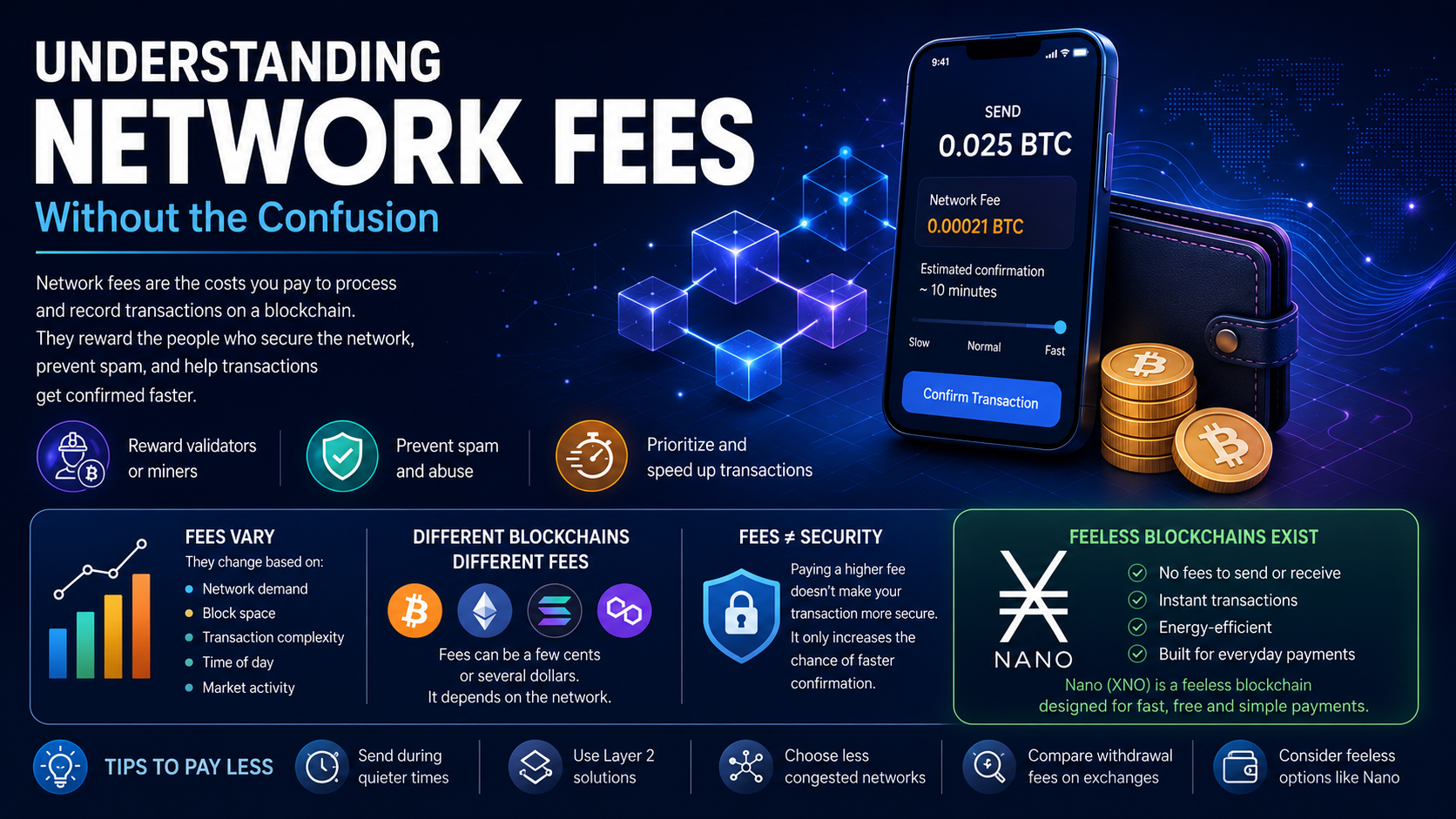
A network fee is the cost of processing and recording a transaction on a blockchain. Whenever you send cryptocurrency from one wallet to another, your transaction needs to be verified and permanently added to the blockchain.
This process isn't free. Computers around the world help secure the network by validating transactions and producing new blocks. Network fees reward the participants who perform this work.
Unlike fees charged by banks or payment processors, network fees usually do not go to the wallet provider or exchange you're using. Instead, they go to the network participants responsible for securing the blockchain.
Why Do Network Fees Exist?
Network fees serve several important purposes.
First, they compensate validators or miners for using computing power, electricity, hardware, and internet resources to keep the blockchain running.
Second, they prevent spam. If sending transactions were completely free, malicious users could flood the network with millions of meaningless transactions, making it difficult for legitimate users to use the blockchain.
Finally, fees help prioritize transactions. During periods of heavy activity, users willing to pay higher fees typically have their transactions processed sooner.
Who Receives the Fees?
The answer depends on the blockchain.
On Proof of Work networks like Bitcoin, miners receive the network fees as part of their mining rewards.
On Proof of Stake networks like Ethereum, Solana, Cardano, Avalanche, Sui, and many others, validators receive most or all of the fees for validating transactions. Some blockchains also burn a portion of the fee, permanently removing those coins from circulation.
The exact distribution varies between networks, but the purpose remains the same: rewarding those who secure the blockchain.
Why Are Fees Different on Every Blockchain?
Every blockchain has its own design, capacity, and demand.
Some networks process only a small number of transactions each second, while others can handle thousands.
When many people want to use a blockchain simultaneously, users compete for limited block space. This competition causes fees to rise.
Several factors influence network fees:
- Network demand
- Available block space
- Blockchain architecture
- Transaction complexity
- Current market activity
This is why fees can be a few cents on one blockchain while costing several dollars or even more on another.
Why Do Fees Change Throughout the Day?
Network fees are dynamic rather than fixed.
Imagine a highway during rush hour. When many people try to use it at once, congestion increases. Blockchain networks behave similarly.
Popular events that increase demand include:
- NFT launches
- Memecoin trading frenzies
- Major market volatility
- Large token airdrops
- High-volume decentralized finance (DeFi) activity
During quieter periods, fees often decrease significantly.
Does Paying a Higher Fee Matter?
Usually, yes.
Most blockchains process transactions based partly on the fee attached to them. Higher fees often result in faster confirmation times.
If your transaction isn't urgent, many wallets allow you to choose a lower fee and simply wait longer for confirmation.
Finding the right balance between speed and cost can save money over time.
Why Are Bitcoin Fees Sometimes High?
Bitcoin has intentionally limited block space. Each block can contain only a certain amount of transaction data.
When demand exceeds available space, users compete by offering higher fees to miners.
As a result, Bitcoin fees may become expensive during periods of heavy activity but remain relatively low when network usage decreases.
This limited capacity is part of Bitcoin's design and contributes to its security and decentralization.
Why Did Ethereum Fees Used to Be So Expensive?
Ethereum became famous for periods of very high network fees during the growth of decentralized finance and NFTs.
The blockchain supports smart contracts, which require more computational work than simple transfers. More complex transactions generally consume more resources and therefore require higher fees.
Ethereum has introduced several improvements over the years that have helped make fees more predictable, while Layer 2 networks have significantly reduced transaction costs for many users.
What About Solana, Polygon, and Other Networks?
Many newer blockchains were designed with scalability in mind.
Networks such as Solana, Polygon, Avalanche, Sui, Base, Arbitrum, and Optimism can often process transactions for only a fraction of a cent or a few cents.
Lower fees make these networks attractive for gaming, micropayments, social applications, NFTs, and frequent trading.
However, every blockchain makes different trade-offs between decentralization, security, speed, and scalability.
Are There Blockchains Without Network Fees?
Yes. Although most blockchains require users to pay a network fee, a small number are designed to be completely feeless.
One of the best-known examples is Nano (XNO). Instead of charging users for every transaction, Nano uses a lightweight consensus mechanism called Open Representative Voting (ORV). This allows transactions to be confirmed quickly without requiring miners or transaction fees.
With Nano:
- Sending funds costs nothing.
- Receiving funds costs nothing.
- Transactions are typically confirmed in well under a second.
- The network is energy-efficient and designed specifically for peer-to-peer digital payments.
Because there are no fees, Nano is particularly well suited for everyday purchases, tipping, donations, micropayments, gaming, and international transfers where even tiny fees could become significant.
Some other projects have experimented with feeless or near-feeless transaction models, although many rely on alternative approaches such as resource staking, bandwidth allocation, or application-specific fee structures rather than being entirely free under all circumstances.
Feeless blockchains demonstrate that charging users a transaction fee is not the only way to operate a decentralized network. Instead of rewarding validators through transaction fees, they use different incentive models and network designs to maintain security and prevent spam.
However, feeless networks remain the exception rather than the rule. Most major cryptocurrencies, including Bitcoin, Ethereum, Solana, Avalanche, Cardano, and Polygon, still rely on network fees as a core part of how their blockchains operate.
What Is "Gas"?
If you use Ethereum or compatible networks, you'll often hear the term gas.
Gas is simply the measurement used to calculate the computational work required to perform an action on the blockchain.
Sending ETH requires less gas than executing a complex smart contract.
In simple terms:
- Network fee = what you pay
- Gas = the amount of work your transaction requires
The final fee depends on both the amount of gas needed and the current gas price.
Are Exchange Withdrawal Fees the Same Thing?
Not always.
Many cryptocurrency exchanges charge a withdrawal fee when you transfer assets to your personal wallet.
This fee may include:
- The actual blockchain network fee.
- An additional service fee charged by the exchange.
This is different from the network fee itself.
Wallet applications generally display only the actual blockchain fee, while exchanges may bundle additional costs into a single withdrawal charge.
Can You Reduce Network Fees?
While you can't avoid fees on blockchains that require them, you can often reduce how much you pay by:
- Using less congested networks.
- Sending transactions during quieter periods.
- Using Layer 2 networks where available.
- Combining multiple transfers into one transaction when practical.
- Comparing withdrawal fees across exchanges.
- Choosing a feeless blockchain like Nano when it meets your needs.
A little planning can often save a surprising amount over time.
Do Higher Fees Make Transactions Safer?
No.
Paying a higher fee does not improve the security of your transaction.
It simply increases the likelihood that validators or miners will process it sooner.
Whether you pay a low fee or a high fee, the blockchain verifies the transaction using the same security mechanisms.
Common Misconceptions About Network Fees
Many beginners misunderstand how fees work.
"The wallet company keeps the fee."
Usually false. Most of the fee goes directly to miners or validators securing the blockchain.
"Expensive fees mean I'm being scammed."
Not necessarily. High fees often reflect increased demand on the network.
"Every blockchain charges the same fees."
No. Every network has its own fee model and level of congestion.
"Higher fees make my crypto more secure."
No. They only affect transaction priority.
"All cryptocurrencies charge network fees."
No. While most do, some cryptocurrencies, such as Nano, were designed to operate without transaction fees.
Tips for Beginners
If you're new to cryptocurrency, these simple habits can help:
- Always check the estimated fee before confirming a transaction.
- If the transaction isn't urgent, consider selecting a slower, cheaper option if your wallet offers one.
- Learn which blockchain you're using and what its typical fees look like.
- Keep a small balance of the blockchain's native coin to pay future network fees.
- Compare withdrawal fees before moving funds off an exchange.
- Remember that choosing the right blockchain can often be just as important as choosing the right wallet.
These small steps can prevent unexpected costs and reduce frustration.
Final Thoughts
Network fees are an essential part of most blockchain networks. They reward the people who secure the network, discourage spam, and help transactions flow efficiently.
However, they are not a universal requirement. Feeless cryptocurrencies like Nano demonstrate that alternative blockchain designs can eliminate transaction fees while still providing secure, decentralized digital payments.
Understanding why network fees exist, what influences them, and when you might choose a feeless alternative will help you make better decisions as you explore the world of cryptocurrency. Rather than seeing fees as confusing or unavoidable, you'll recognize them as just one aspect of how different blockchain networks are designed to balance security, decentralization, scalability, and usability.



Pick your reaction
Post your comment