If you've spent any time exploring cryptocurrency, blockchain, or decentralized applications, you've probably come across the term Web3. It's often described as the next evolution of the internet, but for beginners, it can sound confusing or overly technical.
The good news is that the core idea behind Web3 is actually quite simple. It aims to give users more control over their data, digital assets, and online identity instead of relying entirely on large centralized companies. In this article, we'll explain what Web3 is, how it differs from today's internet, and why so many developers, businesses, and communities are building for it.
What Is Web3?
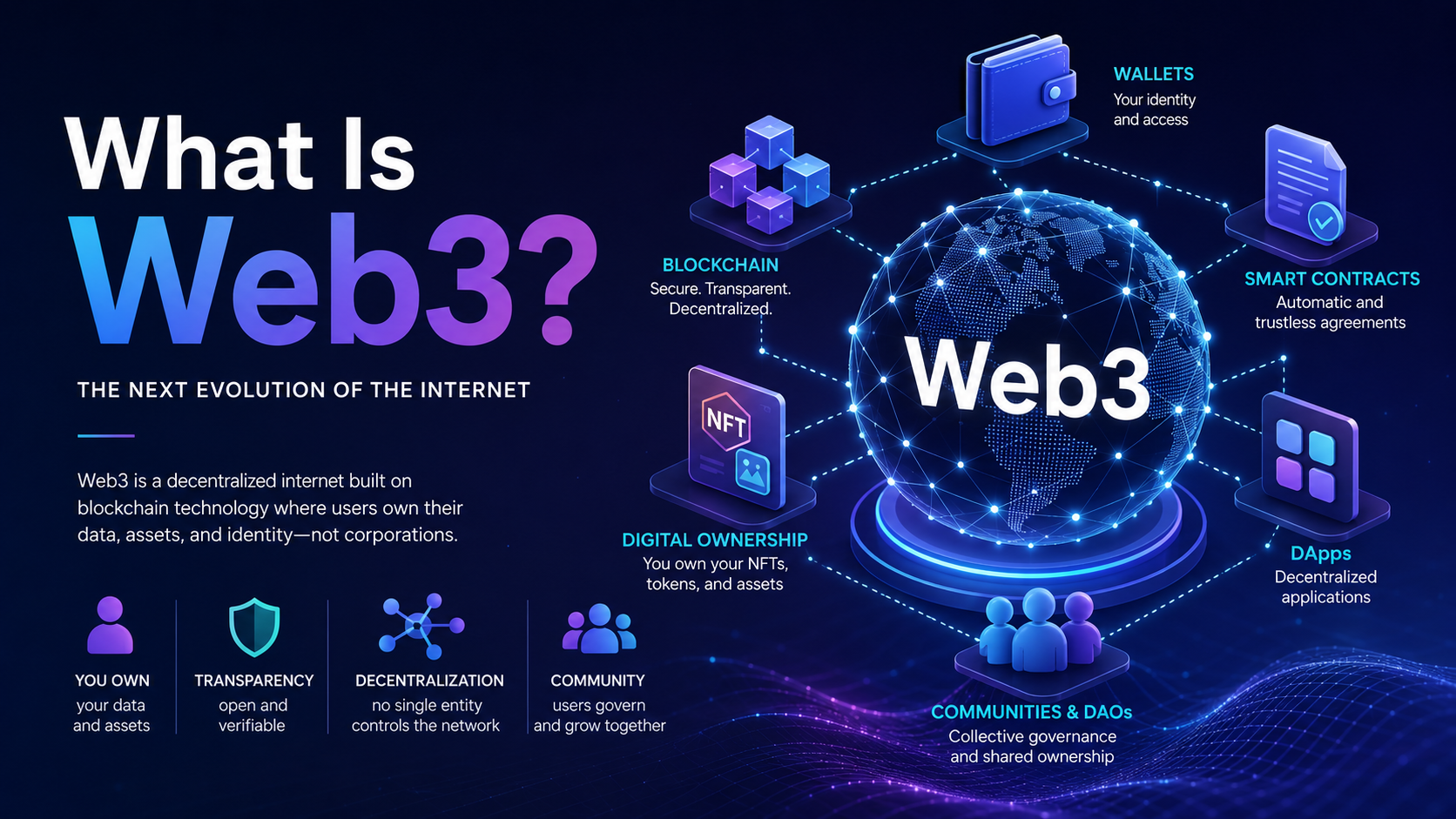
Web3 is a vision of the internet built on blockchain technology. Instead of depending on centralized companies to manage platforms, accounts, and digital assets, Web3 uses decentralized networks where users can own and control their data and interact directly with one another.
Rather than creating an account that belongs to a specific company, many Web3 applications let you connect with a crypto wallet. Your wallet becomes your digital identity and gives you access to a growing ecosystem of applications without needing separate usernames and passwords for every service.
The goal isn't necessarily to replace today's internet overnight, but to offer an alternative that prioritizes ownership, transparency, and user control.
Understanding the Evolution of the Internet
To understand Web3, it helps to look at how the internet has evolved.
Web1: Read-Only Internet
The first generation of the web was mostly made up of static websites. Users could read information, but there was very little interaction.
Examples included:
- Personal websites
- Online encyclopedias
- Company homepages
- News websites
Creating content required technical knowledge, and most visitors simply consumed information.
Web2: Read and Write
The internet we use today is often called Web2.
Users can now create content, interact with others, and build online communities through platforms such as:
- Social media
- Video sharing websites
- Blogs
- Forums
- Online marketplaces
Web2 transformed the internet by making it interactive. However, most popular platforms are owned by centralized companies that control user accounts, algorithms, advertising, and stored data.
While these services are incredibly convenient, users usually don't truly own their digital content or online identity.
Web3: Read, Write, and Own
Web3 introduces ownership into the equation.
Instead of storing everything on centralized servers controlled by one company, many Web3 applications use blockchains and decentralized networks.
This allows users to:
- Own digital assets
- Control their identity
- Transfer assets without intermediaries
- Participate in decentralized communities
- Vote on governance decisions
- Access applications using a crypto wallet
Ownership becomes portable. Your wallet, assets, and reputation can move between compatible applications.
The Building Blocks of Web3
Several technologies work together to make Web3 possible.
Blockchain
A blockchain is a distributed digital ledger that records transactions securely and transparently across many computers.
Because no single organization controls the ledger, it is difficult to manipulate or censor.
Popular blockchains include Ethereum, Solana, Avalanche, Sui, Polygon, and many others.
Crypto Wallets
A crypto wallet is one of the most important tools in Web3.
Instead of simply storing cryptocurrencies, wallets also allow users to:
- Verify their identity
- Connect to decentralized applications
- Sign transactions
- Manage digital collectibles
- Store blockchain-based assets
Your wallet often replaces traditional usernames and passwords.
Smart Contracts
Smart Contracts are programs stored on a blockchain that automatically execute predefined rules.
For example, a Smart Contract can:
- Exchange tokens
- Sell NFTs
- Distribute rewards
- Run decentralized finance applications
- Manage voting systems
Because the rules are written into code, participants don't need to trust a central authority to execute them fairly.
Decentralized Applications (dApps)
Web3 applications are commonly called decentralized applications, or dApps.
Unlike traditional apps that depend entirely on centralized servers, dApps combine blockchain technology with user-friendly interfaces.
Examples include:
- Decentralized exchanges
- NFT marketplaces
- Blockchain games
- Lending platforms
- Social networks
- Community governance platforms
What Makes Web3 Different?
Several characteristics distinguish Web3 from traditional internet services.
Digital Ownership
One of Web3's biggest ideas is ownership.
If you own cryptocurrency or an NFT, those assets are stored in your wallet rather than inside a company's private database.
As long as you control your wallet's private keys, you control your assets.
Transparency
Many Web3 projects publish their Smart Contracts and transaction history on public blockchains.
Anyone can verify transactions, token supplies, and contract behavior.
This openness helps build trust and accountability.
Decentralization
Instead of relying on one company or server, Web3 applications often operate across thousands of computers worldwide.
This reduces single points of failure and makes censorship more difficult.
Permissionless Access
Most Web3 applications are open to anyone with an internet connection and a compatible wallet.
You generally don't need approval from a company before participating.
Community Governance
Some projects allow token holders to vote on upgrades, funding decisions, and future development.
This gives communities a direct voice in how projects evolve.
Common Examples of Web3
Many people already use Web3 without realizing it.
Examples include:
- Buying cryptocurrency
- Trading NFTs
- Participating in decentralized finance (DeFi)
- Playing blockchain-based games
- Joining decentralized autonomous organizations (DAOs)
- Using blockchain naming services
- Collecting digital memberships
- Voting on community proposals
The Web3 ecosystem continues to expand into entertainment, finance, gaming, education, identity, and social networking.
Benefits of Web3
Web3 offers several potential advantages.
Greater User Control
Users control their wallets and digital assets rather than depending entirely on centralized platforms.
Increased Transparency
Public blockchains allow anyone to inspect transactions and verify important information.
Global Accessibility
Many Web3 services are available worldwide without requiring traditional banking infrastructure.
Interoperability
Assets created on one application can often be used across many compatible platforms.
For example, an NFT purchased in one marketplace may also appear in another wallet or marketplace without being transferred manually.
Innovation
Open-source development allows developers around the world to build on existing protocols, encouraging rapid innovation.
Challenges of Web3
Despite its potential, Web3 also faces significant challenges.
Complexity
Managing wallets, private keys, and blockchain transactions can be intimidating for beginners.
Improving usability remains one of the industry's biggest priorities.
Security Risks
While blockchains themselves are highly secure, users remain responsible for protecting their wallets.
Losing private keys or falling victim to scams can result in permanent loss of assets.
Scalability
Some blockchains struggle with network congestion during periods of high demand.
Many projects are actively developing faster and more efficient scaling solutions.
Regulation
Governments around the world are still developing rules for cryptocurrencies, digital assets, and decentralized applications.
The regulatory landscape continues to evolve.
Scams
As with any growing industry, scams exist.
Users should always research projects carefully before connecting wallets, investing funds, or sharing personal information.
Is Web3 Replacing Web2?
Probably not.
Instead, many experts believe Web2 and Web3 will coexist.
Traditional companies are already exploring blockchain technology while continuing to offer familiar web services.
Many future applications may combine the convenience of Web2 with the ownership and transparency offered by Web3.
Rather than replacing today's internet completely, Web3 may gradually become another layer of it.
Why Communities Matter in Web3
Communities play an especially important role in Web3.
Many successful blockchain projects grow through active communities rather than traditional advertising.
Members contribute by:
- Creating educational content
- Helping newcomers
- Testing new features
- Reporting bugs
- Participating in governance
- Organizing events
- Supporting ecosystem growth
Because many projects are open source and community driven, engaged users often have a real influence on their future direction.
Finding trustworthy communities is therefore one of the best ways to learn about Web3 and stay informed about new developments.
Final Thoughts
Web3 represents a new approach to building and using the internet. Instead of placing all control in the hands of centralized companies, it focuses on user ownership, decentralized networks, and transparent systems powered by blockchain technology.
Although the technology is still evolving and there are challenges to overcome, Web3 has already introduced innovative ways to manage digital assets, participate in online communities, and interact with decentralized applications.
For beginners, the most important takeaway is that Web3 isn't just about cryptocurrency. It's about giving users greater control over their digital lives while enabling new forms of collaboration, ownership, and innovation. As the ecosystem continues to mature, understanding Web3 will become increasingly valuable for anyone interested in the future of the internet.


Pick your reaction
Post your comment