

Blockchain technology is constantly evolving. New features, security improvements, and changes to the way a network operates are introduced over time. Because blockchains are decentralized, these updates are not controlled by a single company or authority. Instead, they are proposed, discussed, and adopted by the community.
Sometimes everyone agrees on the changes, but sometimes opinions differ. When that happens, a blockchain fork can occur.
Understanding blockchain forks is important because they influence how networks evolve, how cryptocurrencies function, and sometimes even result in entirely new digital currencies. While the term "fork" may sound complicated, the concept is relatively straightforward once you understand how blockchains are maintained.
What Is a Blockchain Fork?
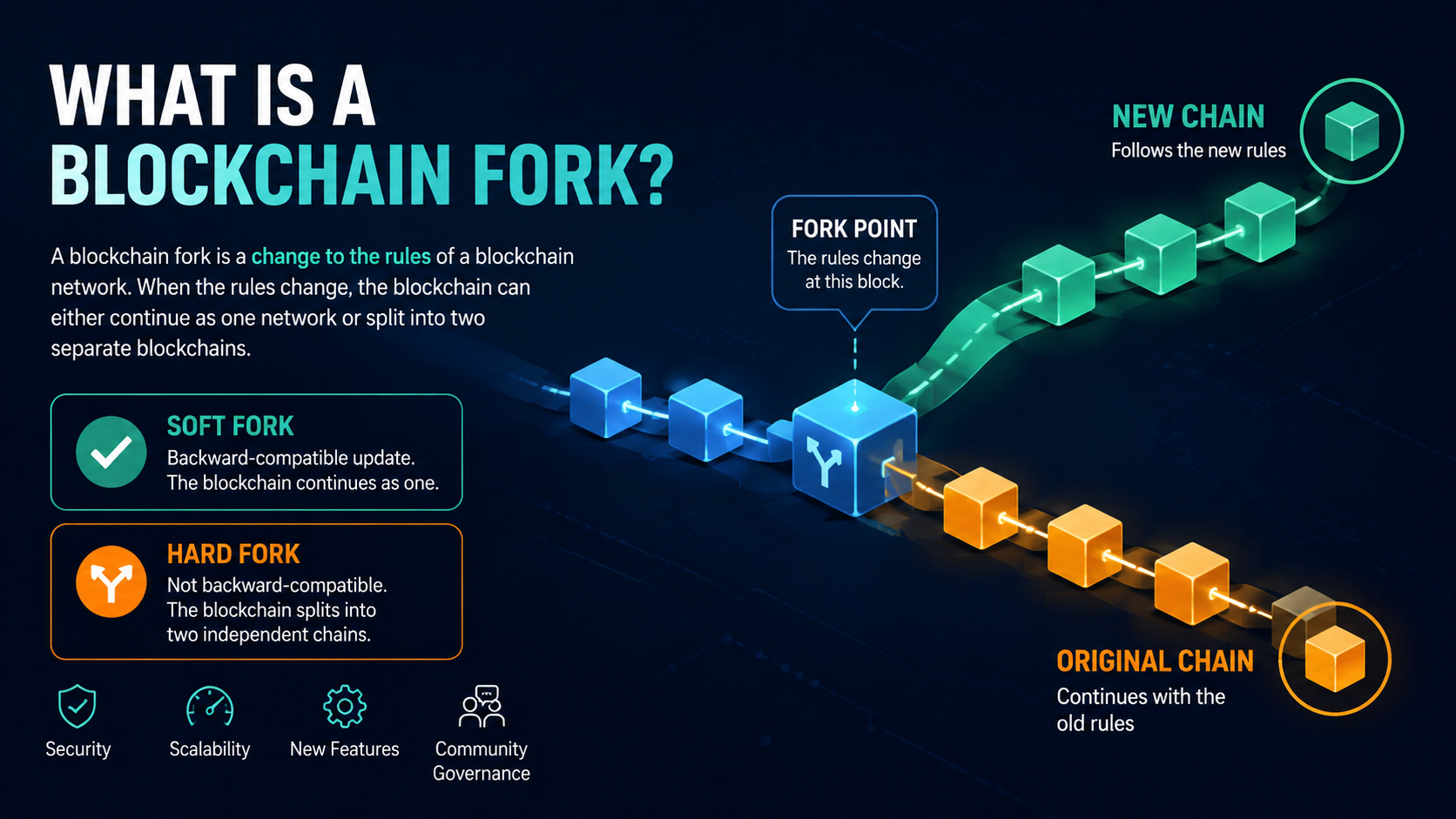
A blockchain fork is a change to the rules that determine how a blockchain network operates. These rules define how transactions are validated, how blocks are created, and what makes a block valid.
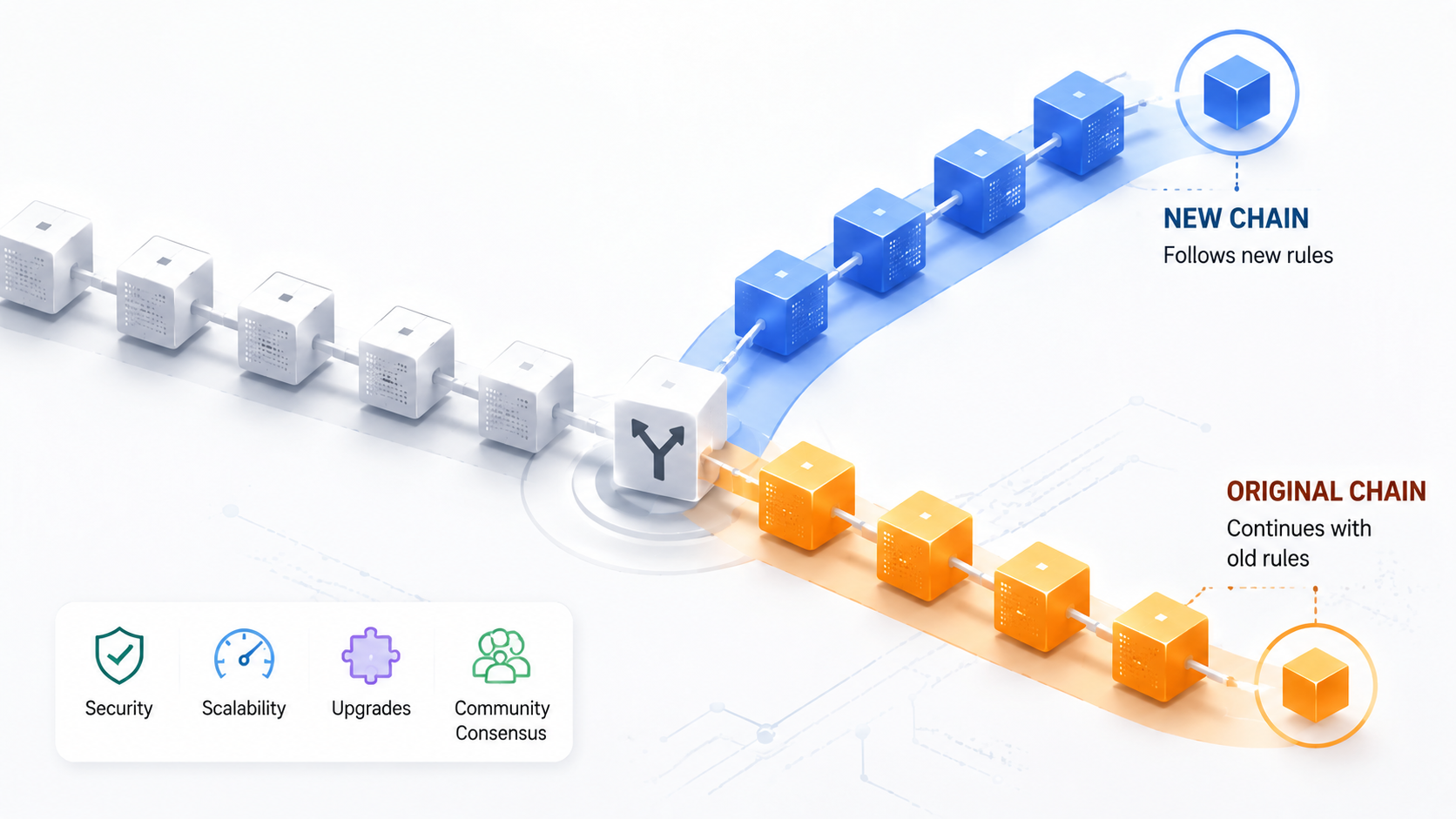
When the rules change, not every participant in the network may update their software at the same time—or even agree with the changes. Depending on the type of update, the blockchain may continue as a single network or split into two separate blockchains.
Think of a blockchain as a road that everyone is traveling together. A fork is like reaching an intersection where one path continues as before while another follows a different route.
Why Do Blockchain Forks Happen?
Forks occur for many different reasons. Some are planned upgrades designed to improve the network, while others happen because members of the community disagree about the future direction of the project.
Common reasons for forks include:
- Improving security
- Adding new features
- Increasing transaction speed
- Reducing network fees
- Fixing software bugs
- Changing economic rules
- Resolving disagreements within the community
Not every fork creates a new cryptocurrency. Many are routine software updates that users barely notice.
The Two Main Types of Blockchain Forks
There are two primary categories of blockchain forks: soft forks and hard forks.
Soft Fork
A soft fork is a backward-compatible update.
This means that computers running the newer software can still communicate with computers running the older version, although older nodes may not fully understand every new feature.
Soft forks usually introduce stricter validation rules without breaking compatibility.
Characteristics of soft forks include:
- Backward compatible
- Usually does not split the blockchain permanently
- Often used for security or efficiency improvements
- Requires most network participants to adopt the update
A well-known example is the Segregated Witness (SegWit) upgrade on Bitcoin, which improved transaction efficiency and solved several technical limitations without creating a permanent chain split.
Hard Fork
A hard fork introduces changes that are not backward compatible.
Nodes running the old software no longer recognize blocks created under the new rules. If enough participants continue using both versions, the blockchain permanently splits into two independent networks.
Each blockchain continues with its own history from the point of the split but can develop differently afterward.
Characteristics of hard forks include:
- Not backward compatible
- Can create a completely new blockchain
- May result in a new cryptocurrency
- Requires users, miners, validators, and exchanges to choose which version to support
Hard forks often attract significant attention because they can create new coins and divide communities.
Famous Examples of Blockchain Forks
Several well-known cryptocurrencies exist because of blockchain forks.
Bitcoin and Bitcoin Cash
In 2017, disagreements within the Bitcoin community about transaction capacity led to a hard fork.
One group wanted larger block sizes to process more transactions directly on the blockchain. Another preferred scaling solutions built on top of the existing network.
The result was the creation of Bitcoin Cash (BCH), which became a separate cryptocurrency with its own blockchain.
Ethereum and Ethereum Classic
Following the 2016 DAO hack, the Ethereum community debated whether to reverse the effects of the attack.
Most participants supported changing the blockchain to restore stolen funds. Others believed that blockchain history should never be altered.
The disagreement led to two independent networks:
- Ethereum (ETH)
- Ethereum Classic (ETC)
Both networks continue to exist today with separate communities and development teams.
Do Forks Create Free Coins?
Sometimes.
If a hard fork creates a new blockchain and both chains continue operating, holders of the original cryptocurrency at the time of the split often receive an equivalent amount of the new cryptocurrency.
For example, when Bitcoin Cash launched, Bitcoin holders who controlled their own private keys generally became eligible to claim an equal amount of Bitcoin Cash.
However, not every hard fork distributes new coins, and support depends on wallets, exchanges, and the specific rules of the fork.
How Are Forks Decided?
Unlike software controlled by a single company, blockchain upgrades usually involve many different groups.
These may include:
- Core developers
- Validators or miners
- Node operators
- Exchanges
- Wallet providers
- Businesses
- Community members
Proposals are often discussed publicly for months before implementation. Different blockchain projects have different governance models, but community consensus usually plays a major role.
What Happens During a Fork?
The process varies depending on the blockchain, but it generally follows these steps:
- Developers propose a change.
- The community discusses the proposal.
- Updated software is released.
- Network participants decide whether to upgrade.
- The update activates at a specific block height.
- The blockchain either continues as one network or splits into two.
Most users do not need to do anything during routine upgrades if they keep their wallets and software updated.
Are Blockchain Forks Good or Bad?
Forks are neither inherently good nor bad.
Positive outcomes include:
- Improved security
- Better scalability
- New features
- Bug fixes
- Continued innovation
Potential downsides include:
- Community disagreements
- Temporary uncertainty
- Price volatility
- Confusion among users
- Duplicate projects competing for adoption
Like software updates in any technology, forks are simply part of the ongoing evolution of blockchain networks.
How Forks Affect Crypto Users
For everyday users, most forks happen behind the scenes.
However, major hard forks may affect:
- Wallet compatibility
- Exchange deposits and withdrawals
- Trading activity
- Token balances
- Network support
Reputable exchanges and wallet providers usually announce important forks well in advance and explain whether users need to take any action.
If you store cryptocurrency in a self-custody wallet, it is a good idea to follow official announcements from the project's developers before a significant network upgrade.
Common Misconceptions About Blockchain Forks
Several myths surround blockchain forks.
"Every fork creates a new coin."
False. Most forks are software updates that do not produce a new cryptocurrency.
"Forks mean something went wrong."
Not necessarily. Many forks are planned improvements that strengthen the network.
"A fork destroys the original blockchain."
Usually not. In a hard fork, both blockchains may continue operating independently.
"Forks are unique to Bitcoin."
No. Nearly every blockchain network can experience forks as part of its development.
The Future of Blockchain Forks
As blockchain technology continues to mature, forks will remain an essential tool for improving decentralized networks. Whether introducing better scalability, stronger security, or entirely new functionality, forks allow blockchain projects to adapt without relying on centralized decision-making.
Different communities will continue making different choices about how their networks should evolve. While disagreements can sometimes lead to separate blockchains, they also demonstrate one of blockchain's defining characteristics: anyone can choose which version of the software they believe best represents the future of the network.
Conclusion
A blockchain fork is a change to the rules of a blockchain network. Some forks are simple software upgrades that improve performance or security, while others lead to entirely new blockchains and cryptocurrencies.
Understanding the difference between soft forks and hard forks helps explain how decentralized networks evolve over time. Rather than being signs of failure, forks are a natural part of open-source development, allowing communities to innovate, debate ideas, and shape the future of blockchain technology together.


Sometimes communities stick together forever, sometimes just for a part of of the journey, it's just the way life works!