

Blockchain technology is often associated with cryptocurrencies, decentralized finance, and digital assets. But behind the headlines, traditional businesses are also exploring how blockchain can improve the way they manage data, coordinate with partners, verify products, process transactions, and interact with customers.
For these companies, adopting blockchain does not necessarily mean accepting cryptocurrency or moving their entire business onto a decentralized network. In many cases, blockchain is simply another piece of infrastructure, one designed to create shared records that are difficult to alter and easier for multiple organizations to verify.
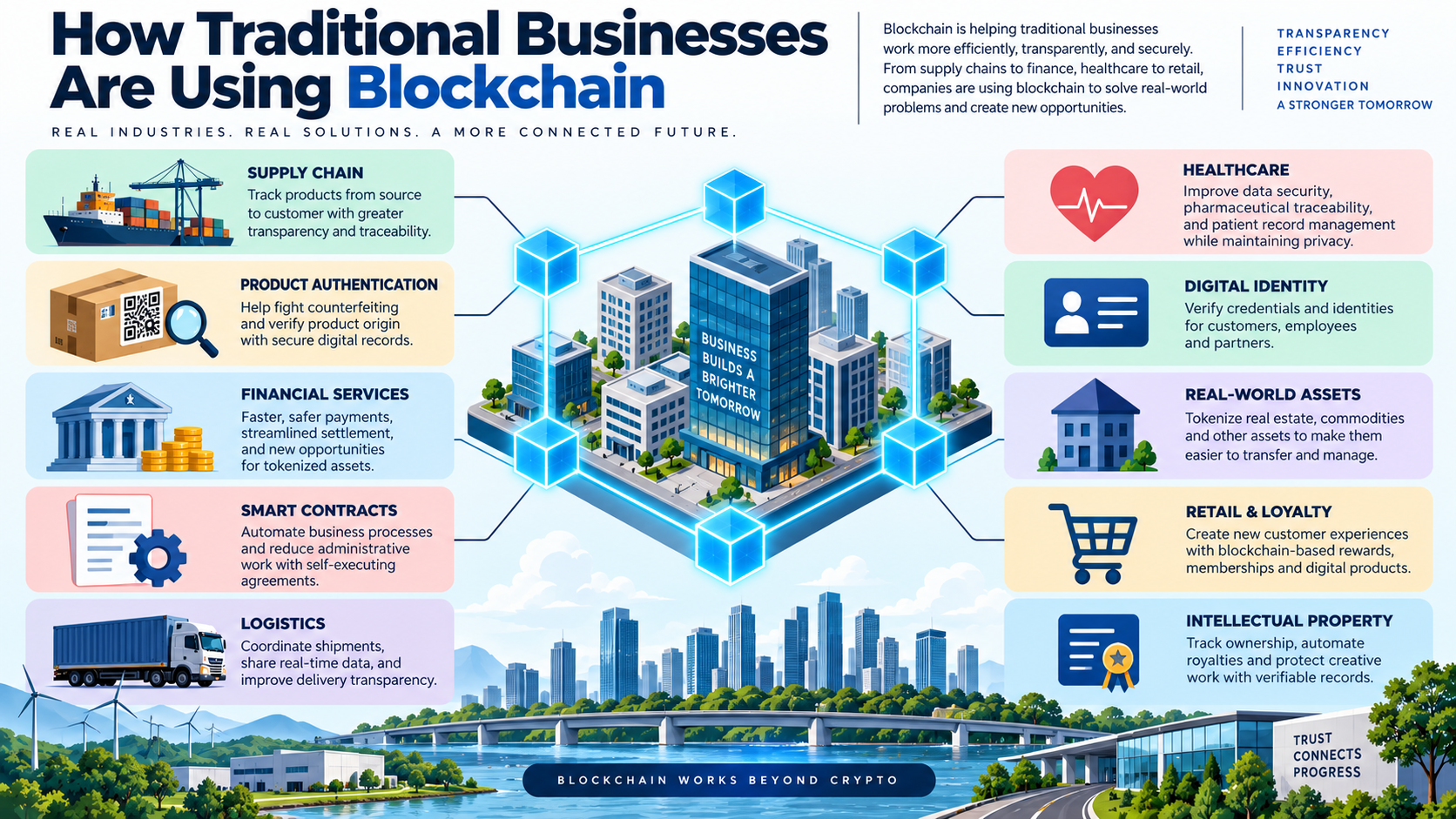
From supply chains and financial services to healthcare, manufacturing, retail, and logistics, blockchain is gradually finding practical applications far beyond crypto trading.
Why Businesses Are Interested in Blockchain
Traditional databases work extremely well when a single organization controls the information. Problems can become more complicated when several independent organizations need to maintain and exchange the same records.
Consider a product moving through a global supply chain. Manufacturers, shipping companies, customs authorities, warehouses, distributors, retailers, and insurers may all maintain their own records. Differences between those records can create delays, disputes, and additional administrative work.
Blockchain offers a different approach.
Instead of every participant maintaining completely isolated records, authorized participants can interact with a shared ledger. Transactions can be recorded in a way that makes previous entries difficult to modify without detection.
Depending on the implementation, this can provide businesses with greater transparency, traceability, automation, and coordination.
However, blockchain is not automatically better than a conventional database. Its strongest use cases generally appear when multiple parties need to share information but do not want to rely entirely on one participant to control the authoritative record.
Supply Chain Tracking
Supply chain management is one of the most frequently discussed business applications for blockchain.
Modern supply chains can involve dozens or even hundreds of companies spread across multiple countries. Tracking where materials originated, when products changed hands, and whether certain requirements were met can be difficult.
Blockchain can create a shared history of a product's journey.
For example, information could be recorded when raw materials are collected, components are manufactured, products are packaged, shipments leave warehouses, goods pass through customs, and items arrive at stores.
Each step creates another entry in the product's history.
This can be particularly useful for industries where provenance matters, including food, pharmaceuticals, luxury goods, electronics, automotive components, and precious materials.
Improving Product Traceability
Closely related to supply chain management is traceability.
Imagine that a food manufacturer discovers contamination in one batch of ingredients. Without detailed tracking, the company may need to recall a large number of products while investigators determine exactly where the affected ingredients were used.
A well-designed blockchain-based tracking system could help businesses identify the relevant batches more quickly.
The same principle can apply to manufacturing defects, counterfeit components, expired pharmaceutical products, or materials that fail to meet environmental standards.
Importantly, blockchain does not guarantee that the information entered into the system is true. If incorrect data is recorded, blockchain can preserve that incorrect information just as effectively as correct information.
Businesses therefore still need reliable methods for connecting physical products with their digital records.
Fighting Counterfeit Products
Counterfeiting is a major problem for many industries, particularly luxury goods, pharmaceuticals, electronics, collectibles, and branded products.
Blockchain can be used as part of a product authentication system.
A manufacturer could create a digital record when an authentic product is produced. That record could contain information such as its serial number, manufacturing date, production location, ownership history, or certification status.
Customers and businesses could then verify the digital record when checking the product.
Technologies such as QR codes, NFC chips, RFID tags, and secure hardware can help connect physical objects with blockchain records.
Again, blockchain is only one component of the system. A blockchain record may be extremely difficult to alter, but the physical identifier attached to a product must also be protected against copying or manipulation.
Financial Services and Payments
Banks and other financial institutions have been experimenting with blockchain technology for years.
Traditional international transactions can involve several intermediaries, reconciliation systems, and settlement processes. Blockchain-based infrastructure has the potential to simplify some of these interactions by allowing financial institutions to exchange assets and information using shared systems.
Possible applications include:
- Cross-border payments
- Securities settlement
- Trade finance
- Tokenized deposits
- Stablecoin payments
- Asset custody
- Identity verification
- Interbank transfers
One particularly important area is tokenization, where traditional assets or financial claims are represented digitally on blockchain networks.
This can potentially allow assets to move through programmable financial infrastructure while maintaining links to established legal and financial systems.
Tokenization of Real-World Assets
Blockchain is increasingly being explored as infrastructure for representing real-world assets digitally.
A token can represent a claim on or interest in something outside the blockchain, such as real estate, government bonds, commodities, investment funds, invoices, or other financial instruments.
For businesses, tokenization can make certain assets easier to transfer, divide, track, or integrate with automated systems.
For example, a financial institution might issue tokenized securities that can be transferred between approved participants using blockchain infrastructure.
However, owning a blockchain token does not automatically provide legal ownership of the underlying asset. The relationship between the token and the real-world asset depends on contracts, regulations, custody arrangements, and the legal framework surrounding the product.
Smart Contracts and Business Automation
Smart contracts are programs that execute on blockchain networks when predefined conditions are met.
Businesses can use them to automate processes that would otherwise require manual coordination.
Imagine a shipment that must arrive at a particular destination before payment is released. Data confirming delivery could trigger a smart contract that automatically initiates the next stage of the transaction.
Similar systems could potentially automate insurance payouts, royalty distributions, escrow arrangements, supplier payments, digital licensing, and other processes.
Smart contracts can reduce certain administrative tasks, but they introduce their own risks. Bugs, incorrect data, poorly designed rules, and security vulnerabilities can all create serious problems.
Automation is only useful when the rules and information behind it are reliable.
Trade Finance
International trade involves a considerable amount of documentation.
Importers, exporters, banks, insurers, shipping companies, customs agencies, and logistics providers may need to exchange invoices, certificates, bills of lading, financing documents, and other records.
Many of these processes have historically relied heavily on paper documents or isolated digital systems.
Blockchain-based platforms can allow participating organizations to share records and track changes through a common infrastructure.
The goal is not necessarily to eliminate every intermediary. Instead, businesses may use blockchain to reduce duplicated data entry, improve document verification, and make it easier for different organizations to coordinate.
Logistics and Shipping
Shipping companies deal with complex networks of ports, carriers, freight forwarders, warehouses, customs agencies, and customers.
Each participant generates information.
Blockchain can provide a shared record of events such as when a container is loaded, when a shipment leaves a port, when customs clearance occurs, and when goods reach their destination.
Combined with Internet of Things devices, blockchain systems could also record information about shipping conditions.
For temperature-sensitive products, for example, sensors might monitor whether goods remained within an acceptable temperature range throughout transportation.
This can be valuable for pharmaceuticals, food, chemicals, and other products that require controlled environments.
Healthcare and Pharmaceutical Applications
Healthcare data is highly sensitive and heavily regulated, making blockchain adoption particularly complex.
Rather than storing large amounts of private medical information directly on a public blockchain, healthcare applications can use blockchain to manage permissions, verify records, track events, or prove that particular information existed without exposing the underlying data.
Pharmaceutical companies can also use blockchain-based systems to improve supply chain traceability.
A medicine could be tracked as it moves from the manufacturer through distributors and pharmacies, helping organizations identify suspicious or counterfeit products.
Privacy remains critical. Blockchain's resistance to modification can become a disadvantage when regulations require personal information to be corrected or deleted, so businesses must carefully design what information is placed on-chain.
Digital Identity and Credentials
Businesses constantly need to verify information about customers, employees, suppliers, and partners.
Blockchain can support systems in which individuals or organizations hold verifiable digital credentials.
For example, a person might receive a digitally signed qualification from a university or professional organization. Instead of contacting the issuer every time someone needs to verify the qualification, a business could cryptographically verify that the credential came from the legitimate issuer and has not been altered.
Similar systems could be used for professional licenses, training certificates, company credentials, product certifications, and membership records.
This does not necessarily require publishing personal information on a blockchain. The blockchain can instead be used to establish trust in the credential while sensitive information remains elsewhere.
Loyalty Programs and Customer Rewards
Traditional companies are also experimenting with blockchain-based loyalty programs.
Conventional loyalty points are usually locked inside one company's ecosystem. Blockchain-based rewards can potentially be made more portable or interoperable.
A group of businesses, for example, could participate in a shared rewards network where customers earn points from one company and redeem them with another.
Some programs may also use tokens or NFTs to represent memberships, access rights, event tickets, discounts, or exclusive benefits.
The technology itself is less important to most customers than the experience. If blockchain makes a loyalty program complicated or expensive to use, it may offer little advantage over a traditional system.
Intellectual Property and Royalties
Creative industries often involve complicated chains of ownership and payment.
A single piece of music, for example, may involve artists, songwriters, producers, publishers, labels, distributors, and licensing organizations.
Blockchain can provide a shared record of ownership information and licensing activity. Smart contracts can also be used to distribute payments according to predefined rules.
Similar ideas can apply to photography, video, publishing, patents, software licenses, and other forms of intellectual property.
The challenge is connecting blockchain records with legally recognized ownership rights. Recording a claim on a blockchain does not automatically prove that the person making the claim actually owns the intellectual property.
Insurance
Insurance involves large amounts of data, documentation, verification, and coordination between different parties.
Blockchain can potentially streamline parts of this process.
For example, a smart contract could automatically process certain insurance claims when trusted external data confirms that predefined conditions occurred.
Flight delay insurance provides a simple example. If reliable data confirms that a flight was delayed beyond a specified threshold, a blockchain-based system could automatically trigger compensation.
More complicated claims would still require investigation and human judgment, but blockchain could automate simpler processes and provide shared records between insurers, customers, brokers, and other participants.
Public Blockchains vs Private Blockchains
Not every business wants its operations recorded on a public blockchain.
Public networks allow a broad group of participants to verify transactions and interact with the network. They can provide strong transparency and interoperability but may create challenges involving privacy, transaction costs, performance, and regulatory requirements.
Private or permissioned blockchain networks restrict participation to approved organizations.
A consortium of banks, logistics companies, or manufacturers might operate such a network together.
Permissioned systems can provide greater control over privacy and participation, although they sacrifice some of the openness and decentralization associated with public blockchain networks.
Some businesses are also exploring hybrid approaches where sensitive information remains within private systems while selected proofs or transactions are anchored to public networks.
Blockchain Does Not Eliminate the Need for Trust
One of the most misleading descriptions of blockchain is that it creates a completely "trustless" business environment.
Real-world business still requires trust.
A blockchain cannot independently determine whether a shipment actually contains the products described in its digital record. It cannot guarantee that a sensor is functioning correctly. It cannot determine whether a property legally belongs to someone simply because a token says it does.
Blockchain can reduce the amount of trust required in certain record-keeping processes, but external data still needs reliable sources.
This is sometimes called the "oracle problem": blockchain systems need mechanisms for obtaining trustworthy information about events outside the blockchain.
The Challenges of Enterprise Blockchain Adoption
Despite its potential, blockchain adoption comes with significant challenges.
Businesses must consider scalability, privacy, cybersecurity, integration costs, regulations, governance, interoperability, and employee training.
Legacy systems can also be difficult to replace.
A company that has spent decades building its internal infrastructure is unlikely to abandon everything simply because blockchain offers a new technical approach.
Instead, blockchain systems are more likely to be introduced gradually and integrated with existing databases, enterprise software, APIs, cloud platforms, and payment systems.
There is also the question of whether blockchain is actually necessary.
If one trusted organization can efficiently operate a database for everyone involved, a blockchain may add unnecessary complexity.
From Blockchain Experiments to Infrastructure
The first wave of enterprise blockchain projects generated enormous expectations. Companies launched pilots, formed consortiums, and experimented with countless applications.
Not every experiment succeeded.
Some projects discovered that traditional databases were cheaper and simpler. Others struggled to convince competitors and business partners to use the same network. Some encountered regulatory, governance, or scalability problems.
These failures are important because they helped clarify where blockchain provides genuine value.
The technology is most compelling when several independent parties need to coordinate around shared data, assets, or rules and when having a common, verifiable record provides a meaningful advantage.
Blockchain Without the Crypto Hype
One of the most interesting developments in enterprise blockchain adoption is that customers may not even realize blockchain is involved.
A customer scanning a product to verify its origin does not necessarily care where the verification record is stored.
A company receiving an international payment cares about cost, speed, and reliability rather than whether blockchain infrastructure was involved behind the scenes.
A logistics manager wants accurate shipment information, not a lesson about consensus mechanisms.
As blockchain technology matures, successful business applications may increasingly treat it as infrastructure rather than a selling point.
The Future of Blockchain in Traditional Business
Blockchain is unlikely to replace conventional databases, payment networks, or enterprise software entirely.
Instead, it is becoming another technology businesses can use when the circumstances make sense.
Its most promising role may be connecting organizations that currently operate separate systems and giving them a shared way to verify transactions, ownership, credentials, and business events.
Tokenized assets, digital identity, supply chain traceability, programmable payments, and interoperable financial infrastructure could become particularly important areas of development.
At the same time, businesses will continue abandoning blockchain projects when conventional technology provides a simpler solution.
That is a healthy development.
The long-term success of blockchain in traditional business will not depend on how often companies use the word "blockchain." It will depend on whether the technology can quietly solve real problems better than the alternatives.
Conclusion
Traditional businesses are using blockchain in ways that extend far beyond cryptocurrency speculation. Supply chain tracking, product authentication, financial settlement, tokenization, logistics, digital credentials, insurance, loyalty programs, and business automation all demonstrate how blockchain concepts can be applied to existing industries.
But blockchain is a tool, not a universal solution.
Businesses still need trustworthy data, strong security, sensible governance, regulatory compliance, and clear economic reasons for adopting it.
The most meaningful blockchain implementations may ultimately be the ones where users barely notice the technology at all. When blockchain becomes invisible infrastructure that makes a process faster, easier to verify, or simpler to coordinate, it moves beyond hype and becomes part of everyday business.



Pick your reaction
Post your comment