

Cryptocurrencies are known for their price volatility. Assets such as Bitcoin and Ethereum can experience significant price swings within a single day, creating both opportunities and risks for investors and users. While volatility is a defining characteristic of many cryptocurrencies, it can make them difficult to use for everyday payments, savings, or business transactions. This challenge led to the creation of stablecoins.
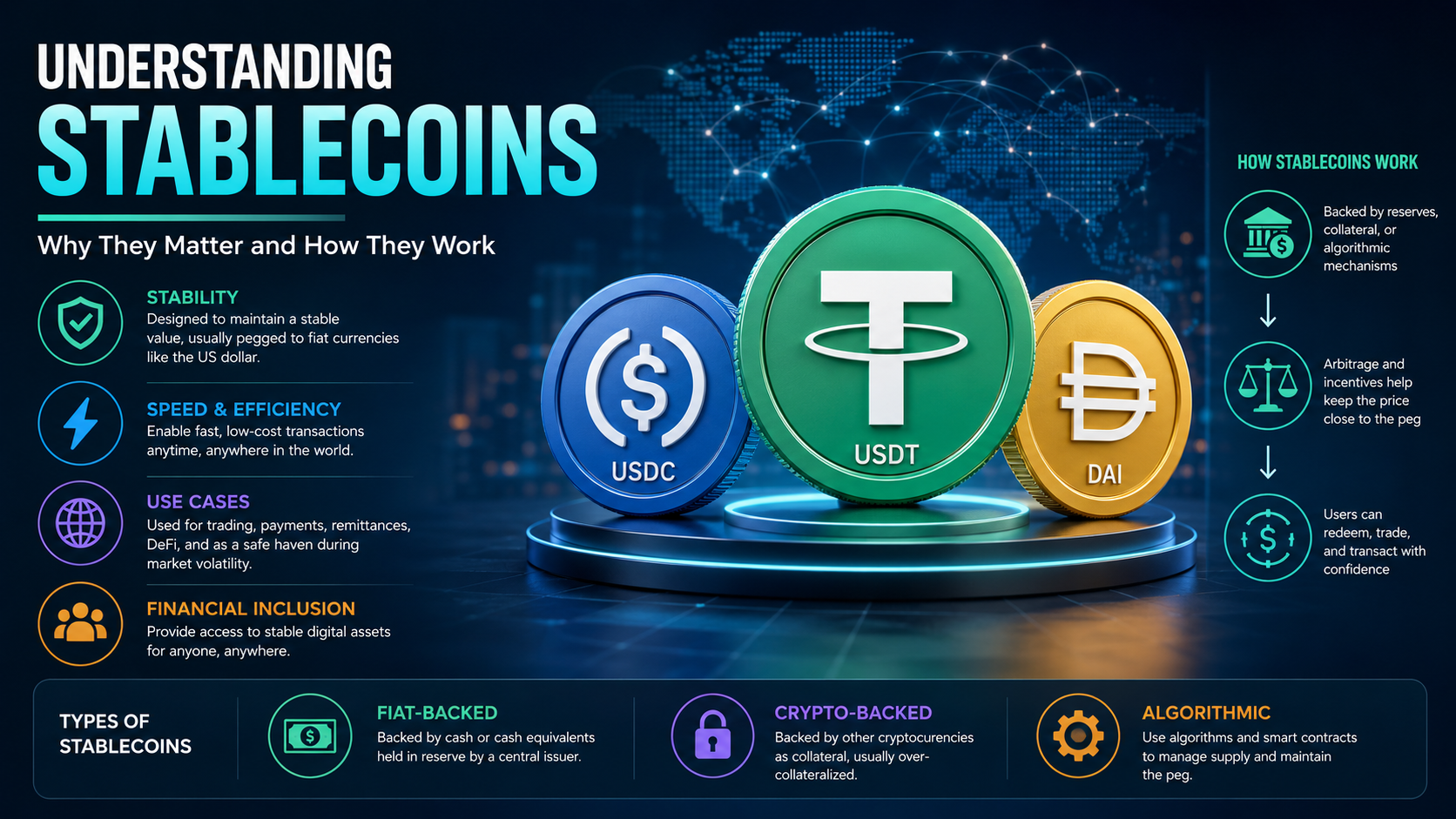
Stablecoins are a special type of cryptocurrency designed to maintain a stable value, usually by being linked to a traditional currency such as the US dollar or the euro. By combining the speed and accessibility of blockchain technology with price stability, stablecoins have become one of the most important building blocks of the modern crypto ecosystem. Today, they are widely used for trading, payments, remittances, decentralized finance (DeFi), and as a safe haven during periods of market uncertainty.
What Are Stablecoins?
A stablecoin is a cryptocurrency that aims to maintain a consistent value relative to a reference asset. In most cases, that reference asset is a fiat currency such as the US dollar, meaning that one stablecoin is intended to be worth approximately one dollar at all times.
Unlike traditional cryptocurrencies, whose prices are determined entirely by market supply and demand, stablecoins use various mechanisms to keep their value stable. These mechanisms can involve reserves of cash and government bonds, other cryptocurrencies, or algorithmic systems designed to regulate supply.
The primary goal is simple: provide a digital asset that can be transferred on a blockchain while avoiding the extreme volatility associated with many cryptocurrencies.
Why Stablecoins Matter
Stablecoins have become a critical part of the cryptocurrency ecosystem for several reasons.
Easier Trading
Many cryptocurrency exchanges use stablecoins as trading pairs. Instead of converting funds back into traditional currencies, traders can move into stablecoins during periods of market uncertainty while remaining within the crypto ecosystem.
Faster Payments
Stablecoins enable near-instant international transactions without relying on traditional banking networks. Users can send funds across borders within minutes, often at a fraction of the cost of conventional wire transfers.
Access to DeFi
Decentralized finance platforms heavily rely on stablecoins for lending, borrowing, liquidity provision, and yield generation. Their predictable value makes them ideal for financial applications built on blockchain networks.
Protection Against Volatility
Investors frequently use stablecoins as a temporary store of value during market downturns. By converting volatile assets into stablecoins, they can reduce exposure to price fluctuations without leaving the cryptocurrency market entirely.
Financial Inclusion
In regions with unstable currencies or limited banking infrastructure, stablecoins can provide access to digital dollars or other stable assets, helping individuals preserve purchasing power and participate in the global economy.
Types of Stablecoins
Not all stablecoins operate in the same way. Different projects use different methods to maintain their price stability.
Fiat-Backed Stablecoins
Fiat-backed stablecoins are the most common type. Each token is backed by reserves held by a central issuer. These reserves may include cash, short-term government securities, or other highly liquid assets.
When users purchase stablecoins, the issuer adds corresponding assets to its reserves. When users redeem their stablecoins, the issuer removes tokens from circulation and returns the underlying value.
Examples include:
- Tether (USDT)
- USD Coin (USDC)
- First Digital USD (FDUSD)
These stablecoins generally maintain their peg through reserve backing and redemption mechanisms.
Crypto-Backed Stablecoins
Crypto-backed stablecoins use other cryptocurrencies as collateral. Because cryptocurrencies can be volatile, these systems typically require over-collateralization.
For example, users may need to deposit $150 worth of cryptocurrency to create $100 worth of stablecoins. If the collateral value falls too much, the system may automatically liquidate positions to maintain stability.
The most well-known example is Dai (DAI), which is governed by the decentralized organization Sky.
Algorithmic Stablecoins
Algorithmic stablecoins attempt to maintain their peg using software-controlled supply adjustments rather than direct collateral.
When demand rises, new tokens may be created. When demand falls, tokens may be removed from circulation. While innovative, purely algorithmic stablecoins have proven difficult to maintain during periods of market stress.
The collapse of TerraUSD in 2022 demonstrated the risks associated with algorithmic stabilization mechanisms and highlighted the importance of transparency and robust collateralization.
How Stablecoins Maintain Their Peg
Maintaining a stable value requires continuous market incentives.
If a dollar-pegged stablecoin trades above $1, traders may purchase newly issued tokens from the issuer and sell them on the market, increasing supply until the price returns to the peg.
If the stablecoin trades below $1, traders may buy discounted tokens and redeem them for the full dollar value, reducing supply and pushing the price back upward.
This process, known as arbitrage, helps keep stablecoin prices close to their intended value.
For decentralized stablecoins, automated smart contracts and collateral management systems perform a similar function by incentivizing market participants to restore balance.
Risks and Challenges
Although stablecoins are designed for stability, they are not risk-free.
Reserve Risk
Users must trust that reserve-backed stablecoins actually hold sufficient assets to support all tokens in circulation. Transparency, audits, and regular reporting are important factors when evaluating a stablecoin.
Regulatory Risk
Governments and financial regulators worldwide are increasingly developing frameworks for stablecoins. Future regulations could affect how stablecoins are issued, traded, and used.
Counterparty Risk
Centralized stablecoins depend on the organizations that issue and manage them. Operational failures, legal issues, or poor management could impact users.
Smart Contract Risk
Decentralized stablecoins rely on smart contracts that may contain vulnerabilities or coding errors. Security audits help reduce these risks but cannot eliminate them entirely.
De-Pegging Events
Under extreme market conditions, stablecoins can temporarily lose their peg. While most major stablecoins recover quickly, significant de-pegging events can create uncertainty and losses for users.
Stablecoins and the Future of Finance
Stablecoins are increasingly being adopted beyond the cryptocurrency industry. Financial institutions, payment providers, fintech companies, and even governments are exploring blockchain-based payment systems that leverage stable digital assets.
Many experts view stablecoins as a bridge between traditional finance and decentralized finance. They provide the familiarity of fiat currencies while benefiting from the efficiency, transparency, and global accessibility of blockchain networks.
As regulatory clarity improves and technology continues to evolve, stablecoins are likely to play an even larger role in international payments, digital commerce, savings products, and financial infrastructure.
Conclusion
Stablecoins have become one of the most important innovations in the cryptocurrency ecosystem. By providing a reliable store of value on blockchain networks, they make digital payments, trading, decentralized finance, and cross-border transfers more practical and accessible.
While different stablecoins use different methods to maintain their value, they all share the same objective: combining the benefits of cryptocurrency technology with the stability users expect from traditional money. As blockchain adoption grows worldwide, stablecoins are positioned to remain a key component of the digital economy for years to come.



Pick your reaction
Post your comment