

When researching a cryptocurrency, price is often one of the first numbers people notice. But the price of a single coin or token tells only a small part of the story. To understand how a crypto asset is structured, it is also important to look at its token supply.
Token supply describes how many units of a cryptocurrency exist, how many are currently available to the market, and how many could eventually be created or released. These numbers can influence scarcity, market capitalization, inflation, incentives, and the long-term economics of a project.
Understanding token supply does not tell you whether a cryptocurrency will increase or decrease in value. It does, however, provide valuable context for evaluating its economics and comparing it with other assets.
What Is Token Supply?
Token supply refers to the number of coins or tokens associated with a cryptocurrency. However, there is rarely just one supply number.
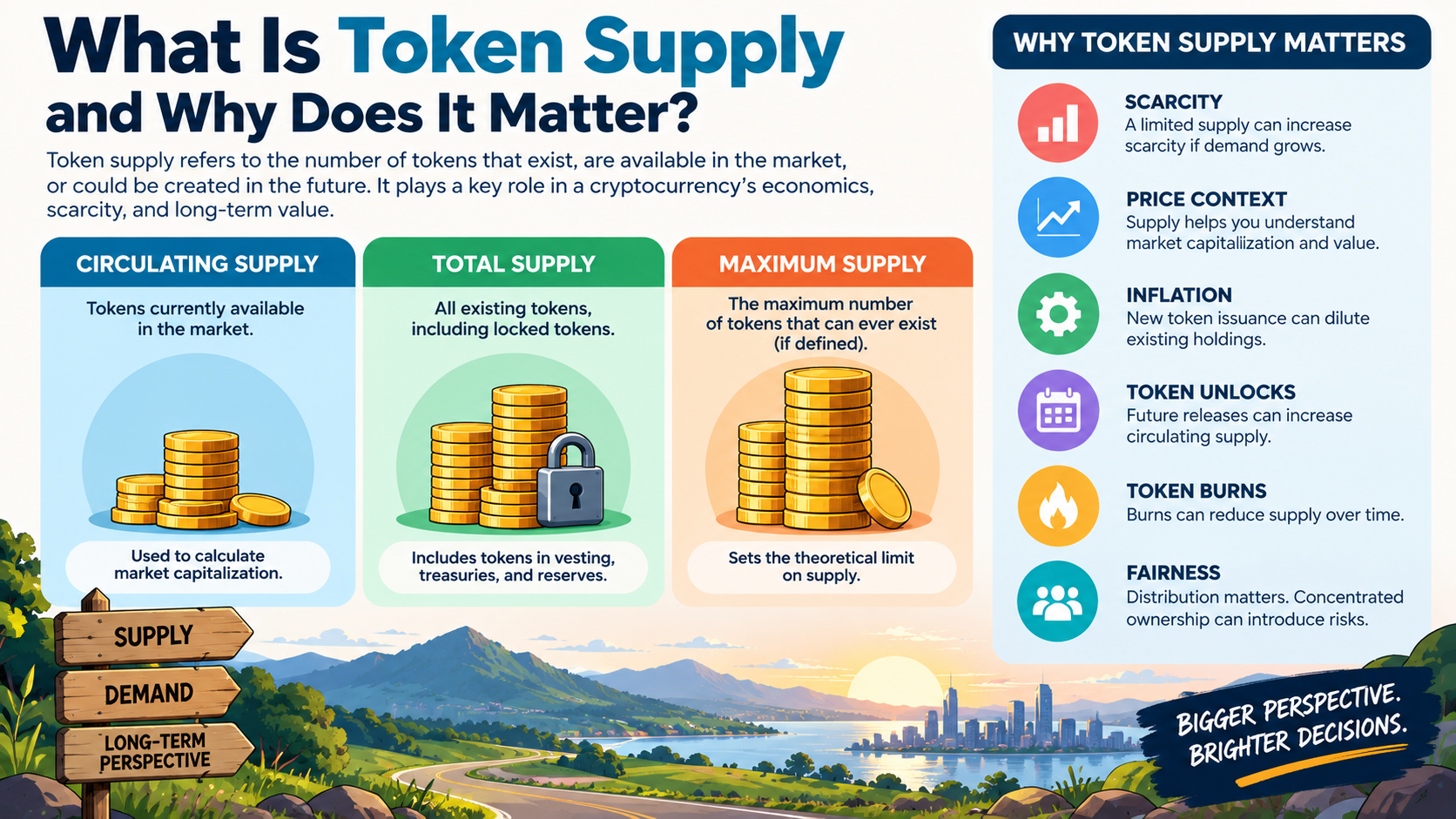
Crypto projects commonly distinguish between several different measurements:
- Circulating supply: Tokens currently circulating and generally available to the market.
- Total supply: Tokens that currently exist, including tokens that may not be circulating.
- Maximum supply: The maximum number of tokens that can ever exist, if the protocol defines such a limit.
These figures can differ significantly.
For example, a cryptocurrency might have 100 million tokens circulating today, a total supply of 150 million, and a maximum supply of 500 million. This means a large number of additional tokens could potentially enter circulation in the future.
Understanding those differences is essential when examining a project's tokenomics.
Circulating Supply
Circulating supply is generally the most relevant supply measurement when discussing a cryptocurrency's current market value.
It represents the tokens considered to be circulating among users and available within the market.
A simplified calculation for market capitalization is:
Market Capitalization = Token Price × Circulating Supply
Suppose a token trades at $2 and has a circulating supply of 50 million tokens.
Its market capitalization would be:
$2 × 50,000,000 = $100 million
This is why comparing cryptocurrencies based only on their individual token prices can be misleading.
A token priced at $0.10 could have a much larger market capitalization than one priced at $100 if its circulating supply is sufficiently larger.
Total Supply
Total supply usually represents the number of tokens that currently exist, minus tokens that have been permanently removed from circulation through mechanisms such as token burns.
Some of these tokens may not yet be circulating.
For example, tokens might be:
- Locked in vesting contracts
- Reserved for developers or team members
- Allocated to a project treasury
- Reserved for ecosystem incentives
- Held for future community rewards
- Assigned to investors but subject to lockups
Because of this, total supply can be substantially higher than circulating supply.
The difference can provide clues about how many tokens might eventually enter the market.
Maximum Supply
Maximum supply represents the theoretical upper limit on the number of tokens that can ever exist.
Not every cryptocurrency has one.
Some protocols have a fixed maximum supply built into their rules, while others allow new tokens to continue being created indefinitely.
A maximum supply can create predictable long-term scarcity, but having a fixed supply does not automatically make an asset valuable. Demand, utility, security, decentralization, adoption, liquidity, governance, and many other factors still matter.
Likewise, an unlimited maximum supply does not automatically make a cryptocurrency economically unsustainable. What matters is how quickly new tokens are created and how that issuance relates to demand and usage.
Why Token Supply Matters
Supply is one side of the fundamental economic relationship between supply and demand.
If demand for an asset increases while its available supply remains relatively constrained, scarcity can become more significant. If supply grows rapidly without a corresponding increase in demand, the additional issuance can place pressure on the value of existing units.
Crypto markets are considerably more complicated than this simple relationship, but token supply provides an important starting point for understanding a project's economic design.
The important question is therefore not simply:
"How many tokens exist?"
It is also:
"How does the supply change over time?"
Token Issuance and Inflation
Many cryptocurrencies introduce new tokens into circulation over time.
New tokens might be distributed through:
- Mining rewards
- Staking rewards
- Validator incentives
- Ecosystem programs
- Community rewards
- Treasury distributions
- Team and investor unlocks
When the circulating supply increases, existing holders effectively represent a smaller percentage of the overall supply unless their holdings increase proportionally.
This is often described as token inflation.
Inflation is not necessarily negative. New token issuance can provide the economic incentives required to secure a blockchain, reward participants, fund development, or encourage ecosystem growth.
The key consideration is whether the issuance serves a sustainable purpose and whether demand can keep pace with the expanding supply.
Token Unlocks and Vesting
One of the most important aspects of token supply is often hidden behind the headline numbers: vesting schedules.
Projects frequently allocate tokens to founders, employees, investors, foundations, and ecosystem programs. Instead of releasing all of those tokens immediately, they may be locked and gradually released according to a predefined schedule.
For example, early investors might receive tokens that remain locked for one year before becoming available gradually over the following three years.
These mechanisms can help prevent large allocations from entering the market immediately after launch.
However, investors should pay attention to future unlocks. A project may have a relatively small circulating supply today while a much larger quantity of tokens is scheduled to become available later.
This difference is sometimes referred to as supply overhang.
Fully Diluted Valuation
Another useful metric is fully diluted valuation, commonly abbreviated as FDV.
A simplified version is:
FDV = Token Price × Maximum Supply
If no maximum supply exists, platforms may instead calculate the figure using another relevant supply measurement.
Imagine a token trading at $5 with:
- 20 million tokens circulating
- 100 million maximum tokens
Its current market capitalization would be:
$5 × 20 million = $100 million
Its fully diluted valuation would be:
$5 × 100 million = $500 million
The large difference between the two numbers tells you that only a fraction of the potential supply is currently circulating.
FDV should not be interpreted as a prediction of what the project will eventually be worth. If additional tokens enter circulation, the token's price can change substantially. Instead, FDV is best viewed as another tool for understanding the relationship between price and potential supply.
Low Token Price Does Not Mean "Cheap"
A common mistake among newcomers to crypto is assuming that a token costing fractions of a cent has more room to grow than a cryptocurrency trading for hundreds or thousands of dollars.
The number of tokens matters.
Consider two hypothetical cryptocurrencies:
Token A
Price: $1
Circulating supply: 10 billion
Market capitalization: $10 billion
Token B
Price: $100
Circulating supply: 10 million
Market capitalization: $1 billion
Despite Token B costing 100 times more per token, its overall market capitalization is only one-tenth that of Token A.
This illustrates why individual token price should rarely be evaluated without considering supply.
Token Burns
Some cryptocurrencies use token burns to permanently remove tokens from the available supply.
Tokens are typically sent to an address or otherwise handled in a way that makes them permanently unusable.
Projects may burn tokens according to:
- Transaction activity
- Protocol revenue
- Scheduled events
- Governance decisions
- Predefined economic rules
Burn mechanisms can reduce supply or offset new issuance.
A cryptocurrency can therefore issue new tokens while simultaneously destroying others. To understand the actual change in supply, both sides need to be considered.
If more tokens are created than burned, supply still increases. If more are burned than created, the supply can decrease.
What Is a Deflationary Token?
A cryptocurrency is commonly described as deflationary when its effective supply decreases over time.
This can occur when token burns consistently exceed new issuance.
However, the term should be interpreted carefully. A protocol may be deflationary during periods of high activity and inflationary during periods of lower activity. Economic rules can also change through governance or protocol upgrades.
"Deflationary" should therefore not automatically be interpreted as "the price will increase."
Reducing supply does not create demand by itself.
Who Owns the Supply?
The distribution of tokens can be just as important as the total number.
Imagine a cryptocurrency with one billion tokens. Knowing that number alone tells you very little about ownership.
If a small group of wallets controls 70% of those tokens, the economic dynamics may be very different from a network where ownership is widely distributed.
When researching token supply, it can therefore be useful to examine allocations to:
- Founders
- Development teams
- Private investors
- Public investors
- Foundations
- Treasuries
- Ecosystem programs
- Community incentives
- Validators or miners
Large concentrations do not automatically indicate a problem, but they can introduce additional risks related to governance, liquidity, and potential selling pressure.
Supply Can Change
Token supply should not always be treated as a permanent number.
Depending on the cryptocurrency, supply rules can change because of protocol upgrades, governance decisions, burns, emissions, migrations, or other mechanisms.
Even cryptocurrencies with clearly defined issuance schedules may experience changes in circulating supply as locked tokens become available.
For this reason, token supply analysis should consider both the current numbers and the rules governing future supply.
Questions to Ask When Researching Token Supply
Instead of looking at a single supply figure, consider the broader tokenomics.
Useful questions include:
- What is the circulating supply?
- What is the total supply?
- Is there a maximum supply?
- How are new tokens created?
- What is the annual issuance rate?
- Are tokens regularly burned?
- How much of the supply is currently locked?
- When will major token unlocks occur?
- How are tokens distributed between insiders and the community?
- What is the difference between market capitalization and FDV?
- Can governance change the supply rules?
- What economic purpose does new issuance serve?
Together, these questions provide a much clearer picture than token price alone.
Supply Is Only Half of the Equation
Scarcity can be important, but scarcity alone does not create value.
A cryptocurrency could have only 1,000 tokens in existence and still have little value if nobody wants them.
Similarly, an asset with billions of units can be valuable if there is sufficient demand for those units.
That is why token supply should be evaluated alongside factors such as:
- Utility
- Adoption
- Network activity
- Security
- Liquidity
- Decentralization
- Developer activity
- Governance
- Community participation
- Long-term demand
Supply tells you how many units exist and how that number may change. Demand tells you whether people actually want those units.
Both sides matter.
Understanding the Bigger Picture
Token supply is one of the fundamental concepts behind cryptocurrency economics.
Circulating supply helps explain current market capitalization. Total and maximum supply provide information about the broader token structure. Issuance schedules reveal potential inflation, while burns can reduce or offset supply growth. Vesting schedules and token unlocks help show when currently locked assets could enter circulation.
Most importantly, token supply provides context.
A low token price does not necessarily mean an asset is cheap. A fixed maximum supply does not guarantee increasing value. A large maximum supply does not automatically make a token unattractive. And a high fully diluted valuation does not predict what a project will eventually be worth.
Rather than focusing on one number, look at how the entire supply system works: how tokens are created, distributed, locked, unlocked, burned, and used.
That broader view can help you better understand the economics behind a cryptocurrency and make more meaningful comparisons between different projects.


Pick your reaction
Post your comment