

XRP is one of the oldest and most well-known cryptocurrencies in the blockchain industry. Created to enable fast, low-cost international payments, it powers the XRP Ledger, an open-source blockchain designed for transferring value efficiently.
While XRP is often associated with banks and financial institutions, the network is also used by individuals, developers, businesses, and decentralized applications. Today, the XRP ecosystem continues to grow with new payment solutions, tokenization projects, decentralized finance (DeFi), NFTs, and community-driven innovation.
What Is XRP?
XRP is the native cryptocurrency of the XRP Ledger (XRPL), a decentralized blockchain launched in 2012. Unlike many cryptocurrencies that rely on mining or staking, the XRP Ledger uses a unique consensus protocol that allows transactions to be confirmed within seconds while consuming very little energy.
The XRP Ledger was designed with one primary goal: making digital payments faster, cheaper, and more scalable than traditional financial systems. Instead of waiting days for international bank transfers to settle, transactions on XRPL typically complete in three to five seconds.
XRP serves as the bridge asset of the network, making it possible to transfer value between different currencies efficiently.
The History of XRP
Development of the XRP Ledger began in 2011 with the goal of creating a faster alternative to Bitcoin. The network officially launched in 2012, introducing a consensus mechanism that eliminated the need for energy-intensive mining.
Ripple, the company most commonly associated with XRP, was founded to build payment technologies using the XRP Ledger. Over the years, Ripple has developed enterprise payment solutions for financial institutions while the XRP Ledger has remained an open-source blockchain maintained by an independent global community of developers and validators.
Despite regulatory challenges in several countries, XRP has remained one of the largest cryptocurrencies by market capitalization and continues to attract developers, businesses, and investors worldwide.
How the XRP Ledger Works
The XRP Ledger uses a distributed network of independent validators instead of miners.
When a transaction is submitted:
- It is broadcast to validator nodes.
- Validators compare proposed transactions.
- Consensus is reached through repeated voting.
- The transaction becomes permanently recorded.
- Settlement is completed in just a few seconds.
Because no mining is involved, transactions require very little electricity compared to proof-of-work blockchains.
XRP Consensus Protocol
Unlike Bitcoin's Proof of Work or Proof of Stake systems, the XRP Ledger uses the XRP Ledger Consensus Protocol.
Independent validators regularly agree on which transactions should be added to the ledger. Consensus rounds occur every few seconds, allowing the blockchain to process thousands of transactions quickly while maintaining security.
Anyone can operate a validator, helping decentralize the network.
XRP Supply
Unlike mineable cryptocurrencies, all XRP was created when the network launched.
Key facts include:
- Maximum supply: 100 billion XRP
- No mining rewards
- A small amount of XRP is destroyed with every transaction
- Transaction fees are burned rather than paid to validators
Although the amount burned per transaction is tiny, it gradually reduces the total supply over time.
Transaction Speed and Fees
One of XRP's biggest strengths is payment efficiency.
Typical characteristics include:
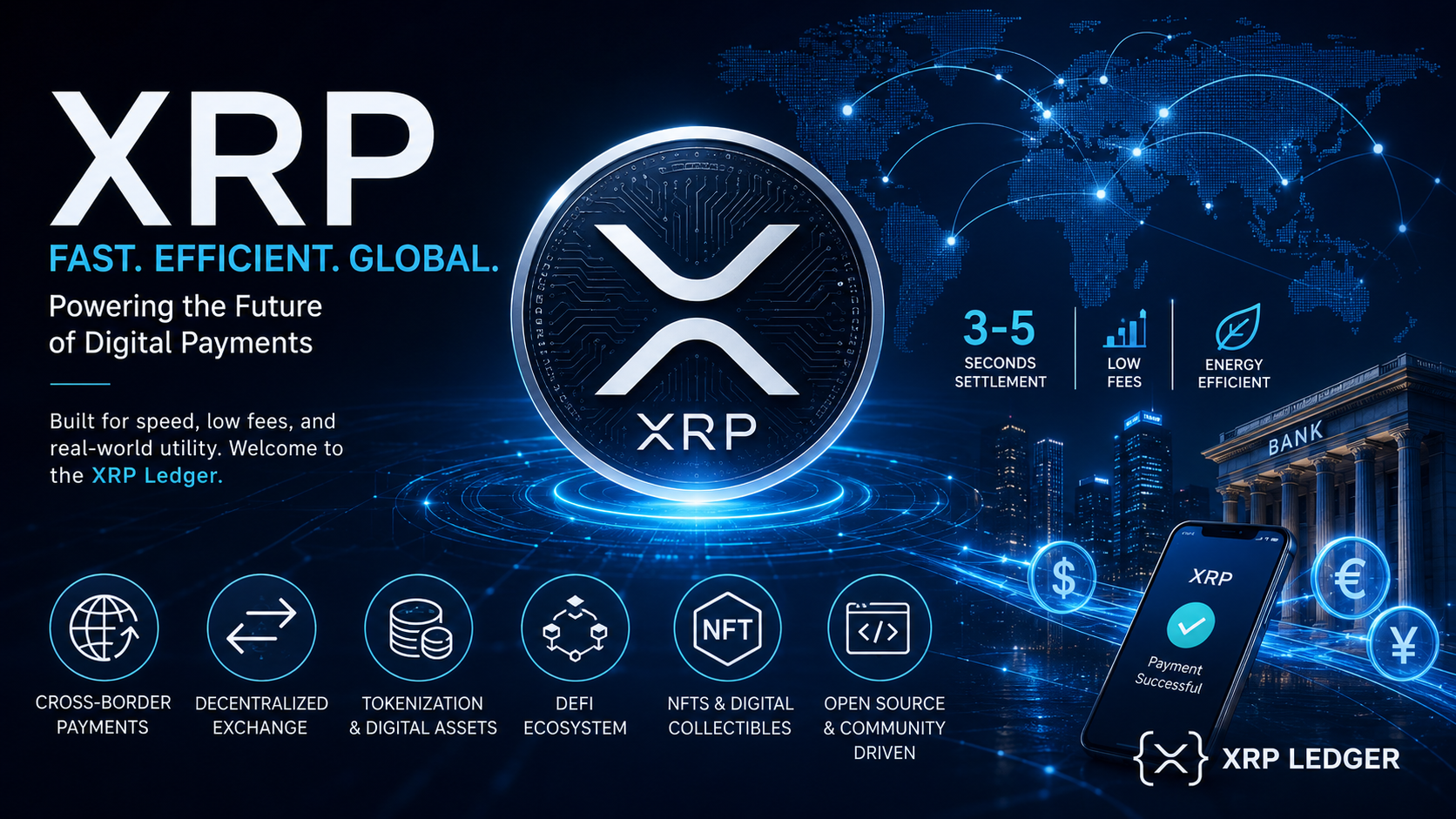
- Settlement in 3–5 seconds
- Very low transaction fees
- High transaction throughput
- Minimal energy consumption
These properties make XRP suitable for both retail payments and enterprise-scale financial applications.
Common Uses of XRP
The XRP Ledger supports far more than simple cryptocurrency transfers.
Popular use cases include:
Cross-Border Payments
Financial institutions can settle international payments much faster than traditional banking systems while reducing costs.
Currency Exchange
XRP can serve as a bridge currency between different fiat currencies or digital assets, simplifying international transfers.
Micropayments
Very low fees allow payments worth only fractions of a cent, enabling business models that are difficult on many other blockchains.
Tokenization
The XRP Ledger allows developers to issue custom tokens representing assets such as:
- Stablecoins
- Loyalty points
- Real estate
- Commodities
- Company shares
- Digital collectibles
NFTs
The XRP Ledger includes native NFT support, allowing creators to mint and trade digital collectibles with low transaction costs.
Decentralized Finance (DeFi)
New decentralized exchanges, lending platforms, automated market makers, and liquidity protocols continue to expand the XRPL ecosystem.
Built-In Decentralized Exchange
One unique feature of the XRP Ledger is its built-in decentralized exchange (DEX).
Unlike many blockchains that require separate smart contracts, XRPL has supported decentralized asset trading directly at the protocol level for years.
Users can trade issued assets without relying on centralized exchanges.
Smart Contracts
Originally, the XRP Ledger focused primarily on payments rather than programmable smart contracts.
However, the ecosystem has expanded significantly through sidechains, developer tools, and new technologies that bring smart contract functionality to XRPL while preserving its fast and efficient core network.
This allows developers to build more advanced decentralized applications without sacrificing the strengths of the main ledger.
Energy Efficiency
The XRP Ledger is considered one of the most energy-efficient major blockchain networks.
Because it does not rely on mining, validator nodes consume only a small fraction of the electricity required by proof-of-work blockchains.
This has made XRP attractive for organizations seeking environmentally responsible blockchain infrastructure.
Security
The XRP Ledger has operated continuously for more than a decade.
Its security comes from:
- Independent validators
- Cryptographic signatures
- Distributed consensus
- Public transaction verification
- Open-source software
The network has demonstrated high reliability throughout its history.
XRP Wallets
Many wallets support XRP, including:
- Xaman
- Ledger
- Trezor
- Trust Wallet
- Exodus
- Gem Wallet
- Atomic Wallet
Hardware wallets provide the highest level of security for long-term storage.
Buying XRP
XRP is available on many cryptocurrency exchanges.
The typical process involves:
- Creating an exchange account.
- Completing identity verification if required.
- Depositing funds.
- Purchasing XRP.
- Withdrawing coins to a personal wallet.
Keeping XRP in your own wallet gives you full control over your funds.
Advantages of XRP
Some of XRP's biggest strengths include:
- Fast transaction confirmation
- Extremely low fees
- Energy-efficient consensus
- Mature blockchain with years of proven operation
- High liquidity
- Built-in decentralized exchange
- Support for tokenization
- Growing DeFi ecosystem
- Large global community
- Strong focus on international payments
Challenges
Like every blockchain, XRP also faces challenges:
- Regulatory uncertainty in some jurisdictions
- Competition from newer payment-focused blockchains
- Public misconceptions about decentralization
- Ongoing competition in cross-border payment solutions
The XRP community continues to work on expanding adoption, developer tools, and real-world applications.
The XRP Community
XRP has one of the largest cryptocurrency communities in the world.
Community members contribute by:
- Developing open-source software
- Creating wallets and developer tools
- Building DeFi applications
- Launching NFT marketplaces
- Running validators
- Organizing conferences and local meetups
- Producing educational content
- Supporting new ecosystem projects
The open-source nature of the XRP Ledger allows developers from around the world to participate in its growth.
Why XRP Matters
XRP has spent more than a decade proving that blockchain technology can provide fast, affordable, and reliable global payments. While the ecosystem originally focused on international money transfers, it has evolved into a broader platform supporting tokenization, decentralized finance, NFTs, digital asset issuance, and enterprise applications. With its efficient consensus mechanism, low transaction costs, and active global community, the XRP Ledger remains one of the most established and widely used blockchain networks in the cryptocurrency ecosystem.
Pick your reaction
Post your comment