

NFTs introduced a new way for digital creators to sell their work directly to collectors. But one of their most talked-about features goes beyond the initial sale: NFT royalties.
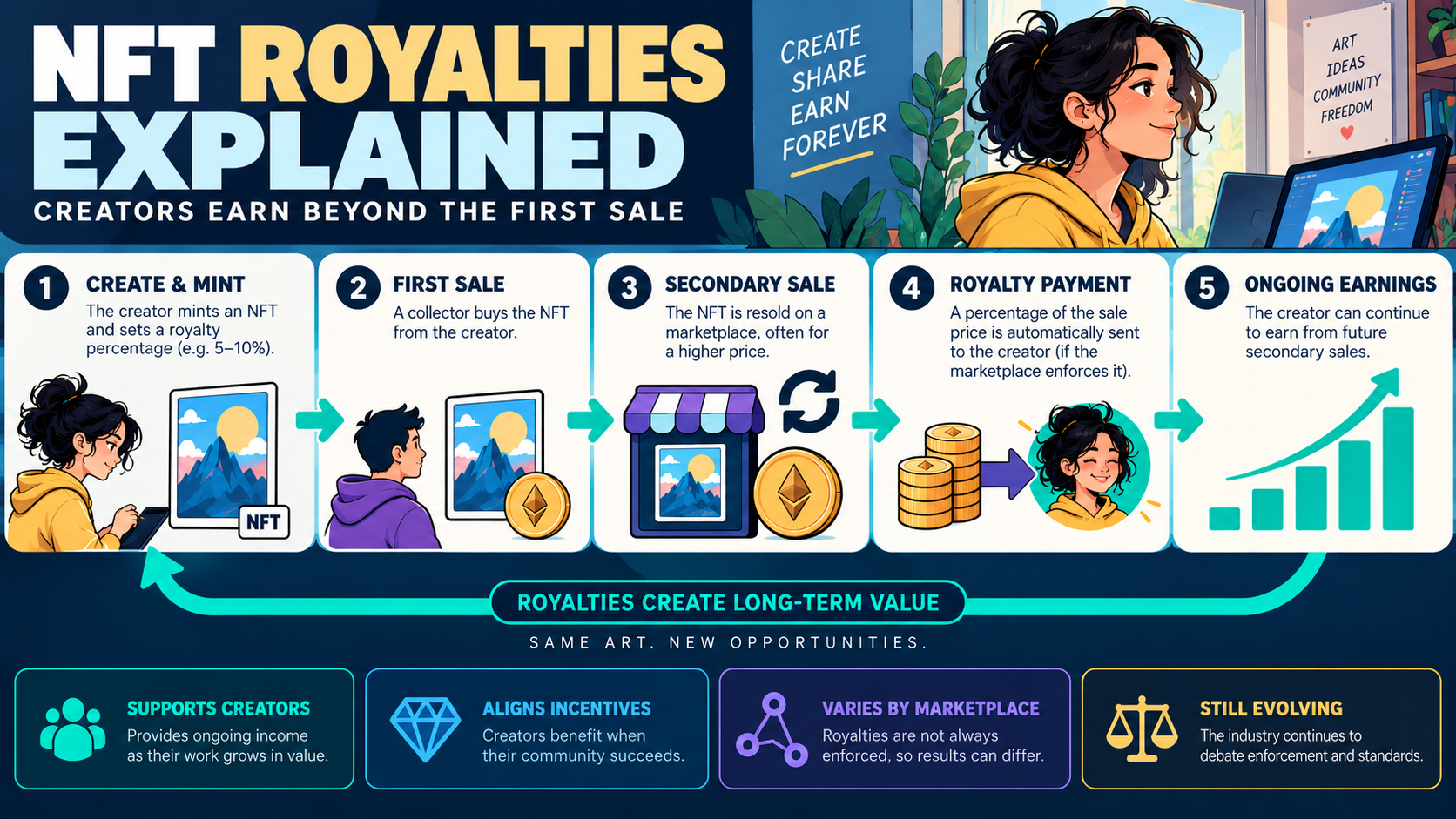
NFT royalties are designed to give creators a percentage of the proceeds whenever an NFT is resold. Instead of earning only when an NFT is first minted or sold, artists, developers, musicians, and other creators can potentially participate in the future value of their work.
The idea sounds simple, but NFT royalties are more complicated than they first appear. They are not automatically guaranteed by the blockchain, marketplaces can handle them differently, and the industry continues to debate whether royalties should be mandatory, optional, or enforced through smart contracts.
What Are NFT Royalties?
NFT royalties are payments intended for the original creator or another designated recipient when an NFT changes hands in a secondary-market sale.
Imagine an artist sells an NFT for $100 and specifies a 5% royalty. A collector later sells that NFT for $1,000. If the marketplace honors the royalty, $50 from the transaction is directed to the designated royalty recipient.
If the NFT is later sold again for $5,000, the same 5% royalty could produce another $250 payment.
This creates a significant difference between NFTs and many traditional forms of creative work. A painter, for example, normally receives money from the original sale of a painting but may receive nothing when that painting is resold years later for a much higher price.
NFT royalties attempt to give creators an ongoing economic connection to their work.
How NFT Royalties Work
NFT royalties generally involve three components:
- The NFT contract, which may contain or expose information describing the royalty recipient and percentage.
- The marketplace, which determines whether and how that royalty information is applied.
- The transaction, where proceeds from the NFT sale are distributed among the seller, marketplace, creator, and potentially other recipients.
This distinction is important because specifying a royalty does not necessarily mean that every future sale will pay it.
An NFT might indicate that its creator should receive a 5% royalty, but another marketplace may choose not to enforce that payment. In some cases, buyers or sellers may be able to select whether they pay royalties at all.
As a result, NFT royalties should not automatically be understood as guaranteed payments.
Are NFT Royalties Stored on the Blockchain?
They can be, but the situation is more nuanced than simply saying that royalties are "built into NFTs."
NFT smart contracts can provide royalty information. On Ethereum and compatible networks, for example, standards such as ERC-2981 allow contracts to communicate royalty information in a standardized way.
A marketplace can ask the NFT contract something similar to:
"If this NFT sells for this amount, who should receive the royalty and how much should they receive?"
The contract can provide an answer.
However, providing royalty information and forcing someone to pay it are two different things.
ERC-2981, for example, standardizes how royalty information is communicated but does not inherently force every marketplace or transfer mechanism to make the payment.
This is one of the most important concepts to understand about NFT royalties.
Why Royalties Are Difficult to Enforce
Blockchains are very good at recording ownership transfers, but determining whether every transfer represents a genuine sale is much harder.
Suppose Alice transfers an NFT to Bob.
The blockchain can see that ownership changed, but what actually happened?
Alice might have sold the NFT to Bob for 2 ETH. She might have given it to him as a gift. Bob might be Alice's second wallet. The NFT might have been transferred as part of a more complicated transaction elsewhere.
Simply charging a royalty whenever an NFT moves could therefore create problems.
This is why many NFT royalty systems historically depended heavily on marketplaces. The marketplace understands that a sale is taking place, knows the sale price, and can distribute the proceeds accordingly.
Marketplace-Enforced Royalties
One common approach is marketplace enforcement.
When an NFT sells, the marketplace calculates the applicable royalty and includes it when distributing the payment.
For example, imagine an NFT sells for 10 ETH with a 5% creator royalty and, for simplicity, no other fees.
The creator receives:
0.5 ETH
The seller receives:
9.5 ETH
This approach is relatively straightforward as long as the transaction takes place through a marketplace that supports and honors the royalty.
The problem appears when the NFT moves somewhere else.
If another marketplace does not enforce royalties, the same NFT could potentially be sold without paying the creator.
Optional vs Mandatory Royalties
The NFT ecosystem has seen considerable debate over whether royalties should be mandatory.
Optional Royalties
With optional royalties, buyers or sellers may decide whether to pay the creator royalty, or a marketplace may simply choose not to enforce it.
Supporters argue that this preserves the permissionless nature of blockchain assets and allows marketplaces to compete with lower transaction costs.
Critics argue that optional royalties undermine the economic model creators relied upon when launching their collections.
Enforced Royalties
Some NFT projects attempt to enforce royalties more aggressively through smart-contract restrictions.
For example, contracts may restrict transfers involving marketplaces or operators that do not comply with certain royalty requirements.
This can make royalty avoidance more difficult, but it introduces trade-offs. Strong restrictions may reduce interoperability, make NFTs incompatible with certain protocols, or give particular contracts and platforms greater control over how tokens can move.
The debate is therefore not simply about whether creators deserve royalties. It is also about how much control should exist over a blockchain asset after it has been sold.
Why Creators Use NFT Royalties
The main attraction is recurring revenue.
Without royalties, a creator might build a successful NFT collection but receive income primarily from the initial mint.
If the collection becomes significantly more valuable later, traders and collectors may generate substantial profits from secondary sales while the original creator receives nothing.
Royalties can change that relationship.
For independent artists, royalty income may help finance future work. For larger NFT projects, royalties can potentially support development, community events, marketing, infrastructure, employees, or other ongoing expenses.
This means royalties can function as more than personal compensation for an artist. They can also form part of a project's broader funding model.
Royalties for NFT Collections
Consider a fictional collection of 10,000 NFTs with a 5% royalty.
If secondary trading generates $2 million in total sales volume, a fully honored 5% royalty would generate:
$100,000 in royalty revenue.
That money could go to the original creator, a development team, a community treasury, multiple contributors, or another designated recipient.
This is why royalty policies can be particularly important when evaluating NFT projects. A project generating significant trading volume may also be generating meaningful revenue through royalties.
However, trading volume alone does not tell you how much royalty revenue was actually collected. The answer depends on where the trades occurred and whether those marketplaces honored the project's royalty settings.
Splitting NFT Royalties
Royalties do not necessarily have to go to one person.
Depending on the implementation, revenue can potentially be divided among multiple recipients.
For example, a 10% royalty could ultimately be distributed between:
- 5% to the primary artist
- 2% to a developer
- 2% to a project treasury
- 1% to another contributor
This can make NFTs useful for collaborative creative projects where several people contribute to a work or collection.
However, buyers should investigate how these arrangements actually work rather than assuming that a royalty labeled "creator royalty" necessarily goes directly to an individual artist.
Royalties Are Different From Marketplace Fees
Creator royalties and marketplace fees are separate concepts.
A marketplace may charge its own fee for facilitating a transaction while an NFT project requests an additional royalty.
Suppose an NFT sells for $1,000 with:
Marketplace fee: 2.5%
Creator royalty: 5%
The marketplace fee would be $25, while the creator royalty would be $50.
Depending on the marketplace's rules and transaction structure, the seller could therefore receive $925 before considering other costs.
When trading NFTs, it is useful to examine the complete fee structure rather than looking only at the listed sale price.
Can NFT Royalties Change?
Sometimes.
The answer depends on how the NFT contract and royalty system were designed.
Some contracts may have fixed royalty settings, while others may allow an authorized account to modify the royalty percentage or recipient.
This creates another consideration for collectors.
If a project can change its royalty from 2% to 10%, for example, future trading costs could be significantly different from those that existed when the NFT was originally purchased.
Before buying an NFT, it can therefore be useful to determine whether royalty settings are fixed or adjustable and who has permission to change them.
Can NFT Royalties Be Removed?
A marketplace can potentially stop honoring royalties even when the NFT contract continues to provide royalty information.
Similarly, an NFT may be moved to a trading venue or transferred through a mechanism that does not apply the expected royalty.
This highlights the difference between royalty signaling and royalty enforcement.
A contract may signal that a creator expects a certain royalty. Whether that expectation becomes an actual payment depends on the implementation and trading environment.
NFT Royalties and Decentralization
Royalties expose an interesting tension within the NFT ecosystem.
One philosophy says that once someone owns an NFT, they should be able to transfer it freely without the creator controlling which marketplaces or protocols they use.
Another argues that creators should be able to define the economic terms under which their work is traded, including compensation from secondary sales.
Both positions involve legitimate design considerations.
Strong royalty enforcement can protect creator revenue but potentially reduce the composability and permissionless transferability associated with blockchain assets.
Weak enforcement preserves flexibility but can make royalty income unpredictable.
There is no universal technical solution that completely eliminates this trade-off.
Royalties Don't Guarantee a Sustainable Project
High royalty revenue does not automatically mean that an NFT project is healthy.
A collection could generate substantial royalties during a short period of speculative trading and then experience very little activity afterward.
Likewise, excessive royalties can discourage secondary trading because buyers know they must overcome higher transaction costs before making a profit.
For example, if an NFT carries a 10% royalty plus marketplace fees, its price may need to rise considerably before a short-term resale becomes profitable.
Creators therefore face their own balancing act: royalties can provide useful revenue, but setting them too high may reduce liquidity and discourage participation.
What Collectors Should Check
Before purchasing an NFT, collectors should understand the project's royalty structure.
Useful questions include:
- What is the royalty percentage?
- Who receives the royalty payments?
- Can the royalty percentage or recipient be changed?
- Which marketplaces honor the royalties?
- Are royalties optional or technically restricted?
- Does the project depend heavily on royalty revenue?
- How are royalty proceeds used?
- Are marketplace fees charged in addition to royalties?
These questions are particularly important for projects that promise continued development funded through secondary-market activity.
What Creators Should Consider
Creators also need to think beyond simply choosing a royalty percentage.
Marketplace compatibility matters. A royalty system that works perfectly on one platform may behave differently elsewhere.
Creators should also consider transparency. If royalty revenue supports project development or a community treasury, clearly explaining where that money goes can help community members understand the project's economic model.
Most importantly, creators should avoid treating expected secondary royalties as guaranteed future income.
NFT markets change quickly, trading volume fluctuates, and marketplace royalty policies can evolve.
The Future of NFT Royalties
NFT royalties remain an evolving part of blockchain technology.
Developers continue experimenting with contract standards, marketplace policies, transfer restrictions, revenue-sharing mechanisms, and alternative ways of funding creators.
The broader discussion also reaches beyond NFTs. Blockchain-based royalty systems could potentially be relevant to music, gaming assets, digital collectibles, publishing, licensing, memberships, and other forms of tokenized media.
But the central challenge remains the same: how can creators receive recurring compensation without sacrificing the open and interoperable properties that make blockchain assets useful?
Different projects will continue answering that question in different ways.
Final Thoughts
NFT royalties introduced a compelling idea: creators could continue benefiting economically as their digital work moves through secondary markets.
But the phrase "NFT royalties" can make the system sound more automatic than it really is.
A smart contract can communicate royalty information, and marketplaces can use that information to distribute payments. Yet royalties are not universally enforceable simply because an NFT exists on a blockchain.
For creators, royalties can provide an important source of recurring revenue. For collectors, they represent an additional cost and an important part of a project's economic structure.
Understanding who receives royalties, how much they receive, whether those payments are enforced, and whether the rules can change provides a much clearer picture of how an NFT actually works.
As with many aspects of NFTs, the technology is only part of the story. Marketplace policies, incentives, community expectations, and the design choices made by individual projects ultimately determine whether royalties work as intended.


Pick your reaction
Post your comment