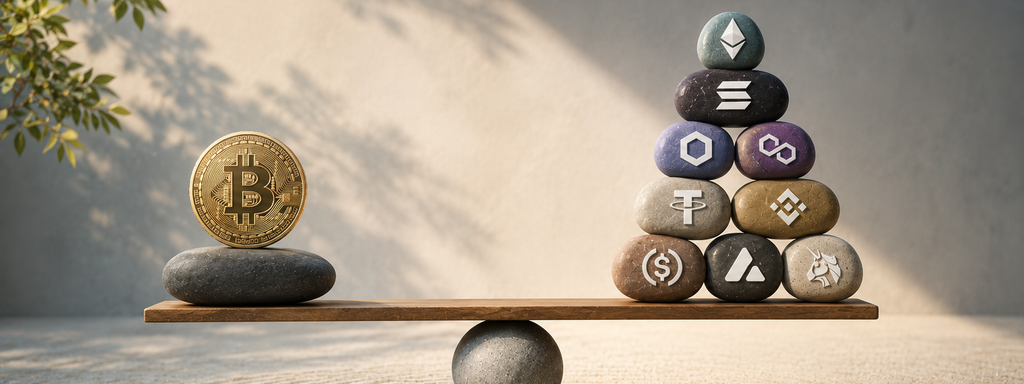

Cryptocurrency can seem full of unfamiliar terminology, and two of the most commonly confused terms are coins and tokens. While many people use them interchangeably, they describe two different types of digital assets with distinct purposes and technical foundations.
Understanding the difference is essential when researching blockchain projects, participating in crypto communities, or making investment decisions.
In this article, we'll explain what coins and tokens are, how they work, where they're used, and why the distinction matters.
What Is a Coin?
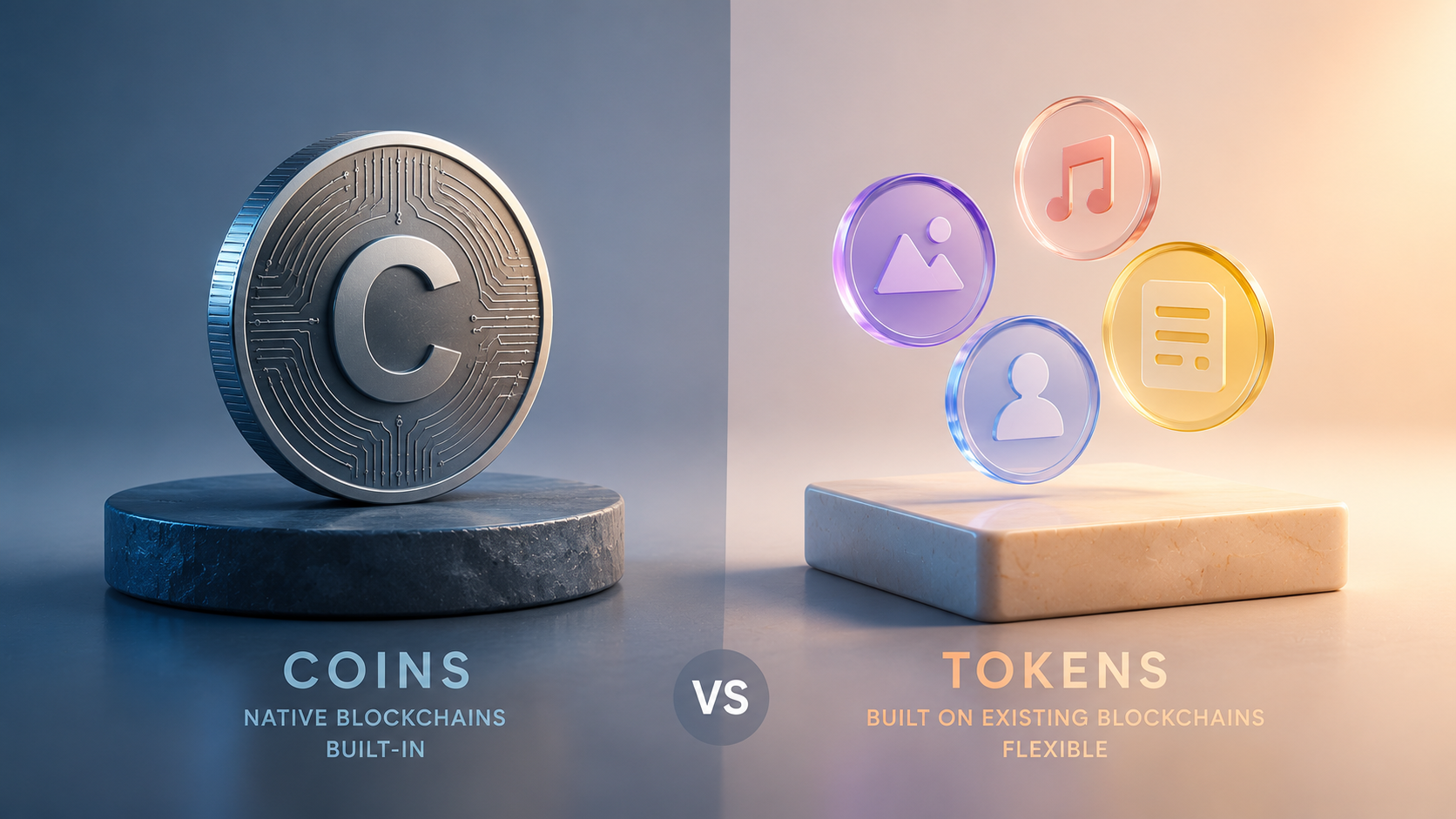
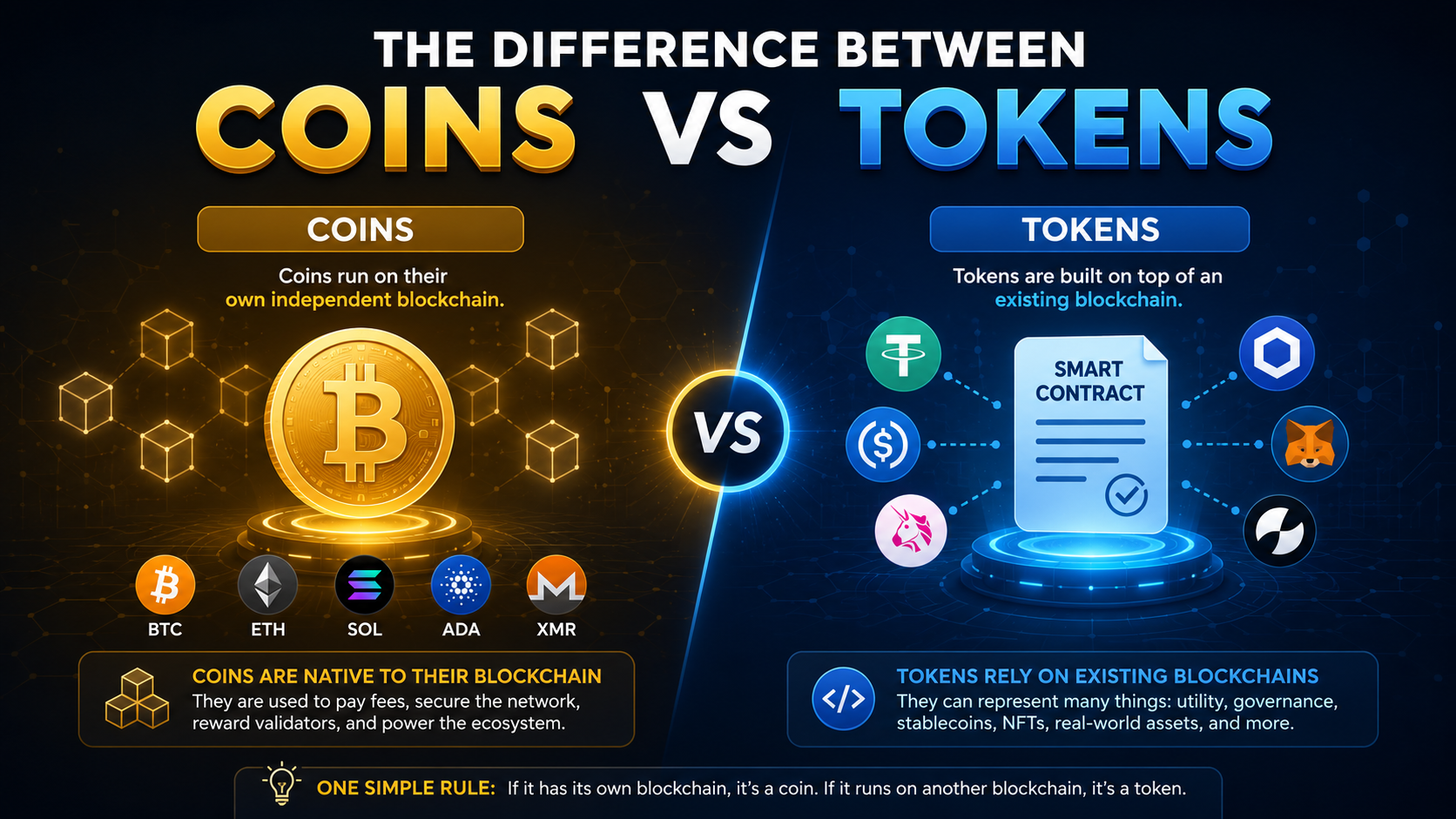
A coin is a cryptocurrency that operates on its own independent blockchain. The blockchain provides the infrastructure that records transactions, secures the network, and allows the coin to function without relying on another blockchain.
Coins are typically used as the native currency of their blockchain. They often pay transaction fees, reward validators or miners, and enable participation in network governance or staking.
Some well-known examples include:
- Bitcoin (BTC) on the Bitcoin blockchain
- Ethereum (ETH) on the Ethereum blockchain
- Cardano (ADA) on the Cardano blockchain
- Solana (SOL) on the Solana blockchain
- Nano (XNO) on the Nano network
- Monero (XMR) on the Monero blockchain
Each of these cryptocurrencies exists because its blockchain was specifically designed to support it.
What Is a Token?
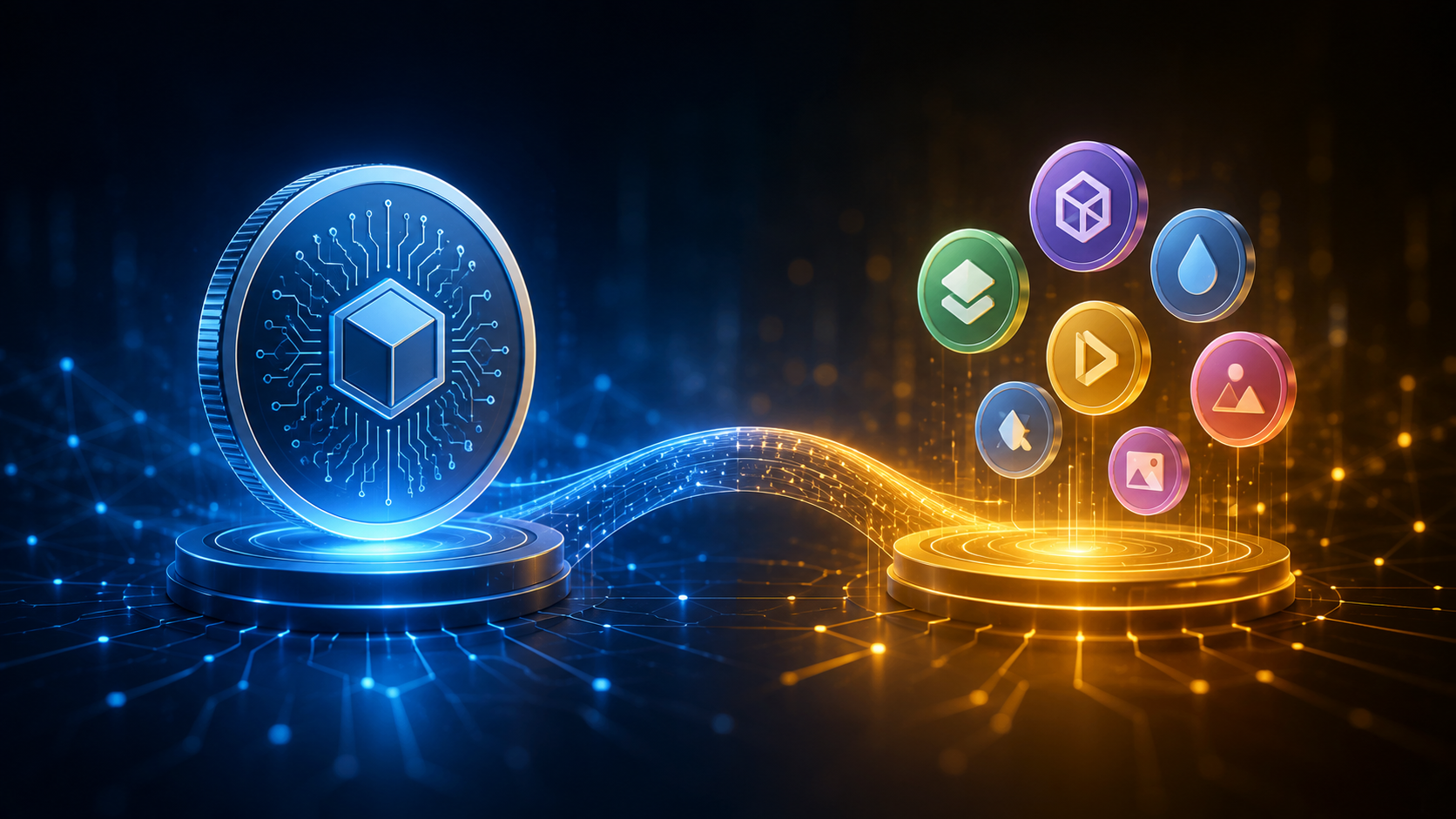
A token is a digital asset that is created on top of an existing blockchain instead of having its own.
Rather than maintaining an independent network, tokens rely on the security and infrastructure of another blockchain. This allows developers to launch new projects much faster than building an entirely new blockchain from scratch.
Ethereum popularized this concept through the ERC-20 token standard, but many other blockchain ecosystems now support their own token standards.
Popular token standards include:
- ERC-20 (Ethereum)
- ERC-721 (Ethereum NFTs)
- ERC-1155 (Ethereum multi-token standard)
- BEP-20 (BNB Smart Chain)
- SPL Tokens (Solana)
- ARC-200 (Alephium)
- Jettons (TON)
Thousands of cryptocurrencies are tokens rather than independent coins.
The Main Technical Difference
The simplest way to distinguish between coins and tokens is to ask one question:
Does the asset have its own blockchain?
If the answer is yes, it is generally a coin.
If the answer is no and it operates on another blockchain, it is a token.
For example:
AssetCoin or Token?BlockchainBitcoin (BTC)CoinBitcoinEthereum (ETH)CoinEthereumSolana (SOL)CoinSolanaChainlink (LINK)TokenEthereumUniswap (UNI)TokenEthereumUSD Coin (USDC)TokenEthereum, Solana, Polygon, Base and others
Why Tokens Exist
Creating an entirely new blockchain is difficult. It requires designing consensus mechanisms, securing the network, attracting validators or miners, and maintaining software over many years.
Building a token is much simpler.
Developers can launch a token using smart contracts on an existing blockchain, allowing them to focus on their application rather than blockchain infrastructure.
This significantly reduces:
- Development time
- Technical complexity
- Security risks
- Startup costs
As a result, most new cryptocurrency projects begin as tokens.
Common Uses for Coins
Coins often serve as the foundation of an entire blockchain ecosystem.
Typical uses include:
- Paying network transaction fees
- Securing the blockchain through mining or staking
- Rewarding validators
- Acting as a store of value
- Transferring money between users
- Participating in governance
Without the native coin, most blockchains would not function.
Common Uses for Tokens
Tokens can represent almost anything of value.
They are commonly used for:
- Governance voting
- Utility within decentralized applications
- Stablecoins pegged to traditional currencies
- Reward and loyalty programs
- In-game assets
- Digital collectibles and NFTs
- Tokenized real-world assets
- Access to services or memberships
Because tokens are highly flexible, they have become one of the primary building blocks of Web3.
Smart Contracts Make Tokens Possible
Most tokens exist because of smart contracts.
A smart contract is a program stored on a blockchain that automatically executes predefined rules.
Instead of creating blockchain software from scratch, developers write a smart contract that defines:
- Total supply
- Distribution rules
- Transfer logic
- Minting and burning
- Permissions
- Governance features
Once deployed, the blockchain enforces these rules automatically.
Can a Token Become a Coin?
Yes.
Some successful projects launch as tokens before eventually developing their own blockchain.
This process is often called a mainnet migration.
During a migration:
- The project launches its own blockchain.
- Token holders exchange their old tokens for native coins.
- The new blockchain becomes the project's primary network.
Several well-known cryptocurrency projects have followed this path, using an existing blockchain to build their community before launching independent infrastructure.
Multi-Chain Tokens
Not every token exists on only one blockchain.
Many projects issue versions of their token across multiple networks.
For example, a stablecoin might exist simultaneously on:
- Ethereum
- Solana
- Polygon
- Avalanche
- Base
- Arbitrum
Although these versions exist on different blockchains, they usually represent the same underlying asset.
Bridges or issuing organizations help maintain consistency between networks.
Wrapped Tokens
Another important concept is the wrapped token.
A wrapped token represents an asset from one blockchain on another blockchain.
For example:
- Wrapped Bitcoin (WBTC) allows Bitcoin to be used within Ethereum-based applications.
- Wrapped ETH versions can exist on other blockchains.
Wrapped tokens improve interoperability by allowing assets to move between blockchain ecosystems.
Coins and Tokens in DeFi
Both coins and tokens play important roles in decentralized finance (DeFi).
Coins often provide:
- Network security
- Transaction payments
- Collateral
Tokens frequently represent:
- Governance rights
- Liquidity provider shares
- Lending positions
- Stable assets
- Yield-bearing assets
Most DeFi applications rely on a combination of native coins and application-specific tokens.
Why the Difference Matters
Knowing whether an asset is a coin or a token can help you better understand a project.
Questions worth asking include:
- Does the project control its own blockchain?
- Which blockchain secures the asset?
- What transaction fees are required?
- Can the token be used across multiple networks?
- Is the asset mainly a payment currency or part of a larger application?
Answering these questions gives valuable insight into a project's technology and long-term goals.
Common Misconceptions
"Every cryptocurrency is a coin."
False. Many of the largest cryptocurrencies by market capitalization are actually tokens operating on existing blockchains.
"Tokens are less valuable."
Not necessarily. Some tokens have achieved multibillion-dollar market capitalizations and power some of the largest decentralized applications in the industry.
"Coins are always better."
Not always. Whether a coin or token is more suitable depends entirely on the project's purpose. Many successful applications have no need for an independent blockchain.
"Tokens are only used for NFTs."
NFTs are one type of token, but most tokens are fungible assets used for payments, governance, decentralized finance, gaming, identity, and many other applications.
The Future of Coins and Tokens
The distinction between coins and tokens will likely remain important as blockchain technology continues to evolve.
New Layer 1 blockchains will introduce their own native coins, while developers will continue creating innovative tokens for decentralized finance, gaming, artificial intelligence, real-world asset tokenization, identity, and countless other use cases.
At the same time, improvements in interoperability and cross-chain technology are making it easier for coins and tokens to interact across multiple blockchain ecosystems, creating a more connected crypto landscape.
Conclusion
Coins and tokens are both digital assets, but they serve different roles within the blockchain ecosystem. A coin operates on its own blockchain and typically powers the network itself, while a token is built on an existing blockchain and often supports applications, services, or specific use cases.
Understanding this distinction makes it easier to evaluate cryptocurrency projects, interpret blockchain discussions, and navigate the growing world of Web3. Whether you're exploring decentralized finance, NFTs, gaming, or digital payments, recognizing the role of coins and tokens is a valuable foundation for understanding how blockchain ecosystems work.

Pick your reaction
Post your comment